

KOSPI Selloff: Asia Braces for AI Market Rout
KOSPI Selloff: Asia Braces for AI Market Rout
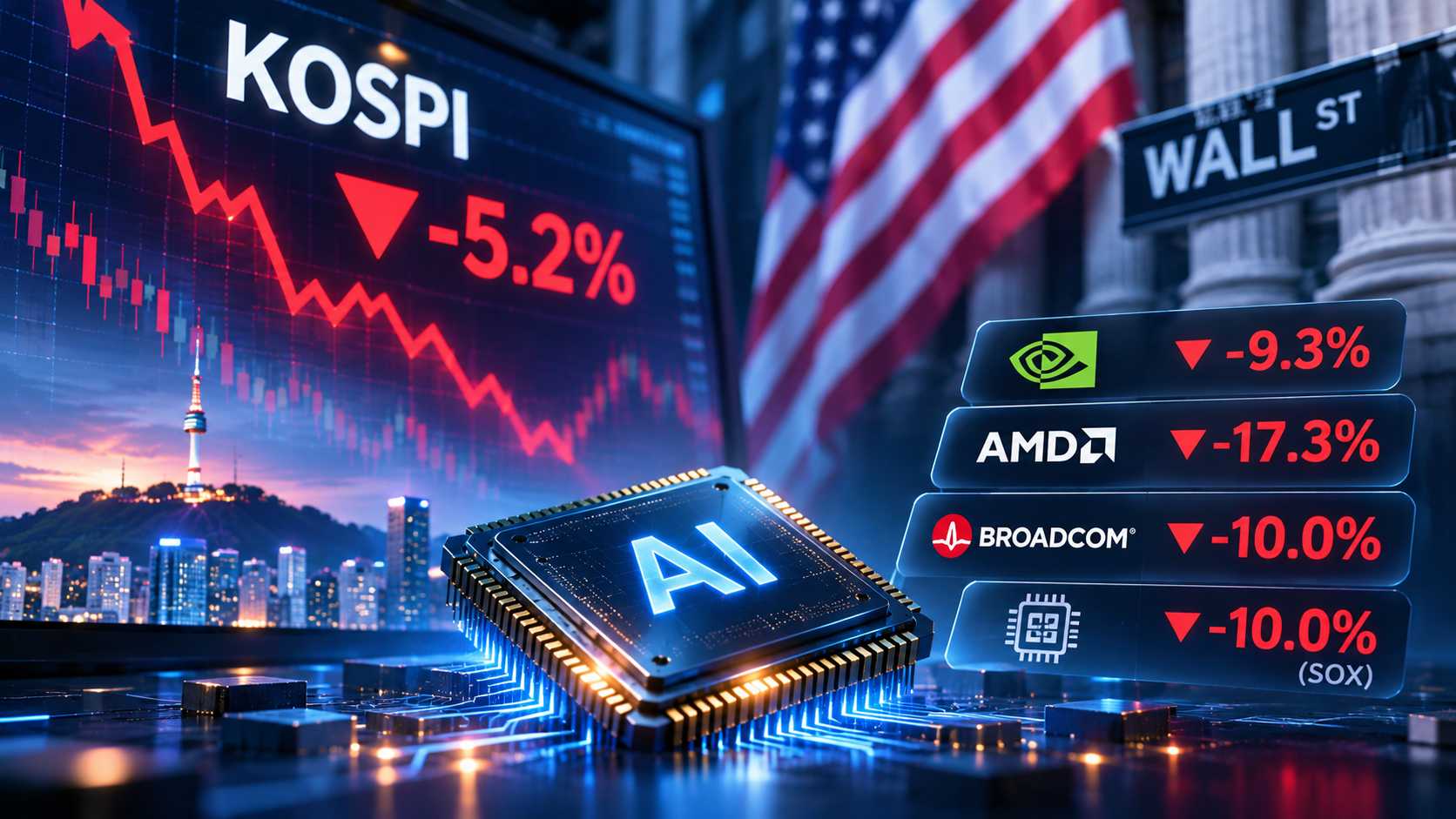
The KOSPI selloff that began on Wall Street has arrived in Asia with full force. South Korea's benchmark index fell 5.2% on Friday, closing at its lowest level in ten months. The index has now shed more than 46% from its mid-June peak of 9,100, dropping below the 5,000 mark. In Taiwan, the TAIEX posted its worst week since 2001. Authorities in both countries spent the weekend activating emergency measures. And this Monday morning, traders across the region are deciding whether the floor has been found or whether more pain is ahead.
This is not a contained correction. The KOSPI selloff is the regional expression of a broader global repricing of AI stocks and semiconductor valuations. What started as a question about returns on AI capital spending has become a full market event, pulling indices from Seoul to Taipei into bear or correction territory and forcing governments to intervene at a scale not seen since the pandemic-era dislocations of 2020.
This article breaks down what happened, what governments are doing about it, and what traders need to watch this week.
What Triggered the KOSPI Selloff
The immediate trigger is Wall Street. The S&P 500 entered correction territory last week, closing below 7,000 for the first time since the summer. The Nasdaq fell 5.3% on Friday alone and is now down nearly 20% from its October 6 record high, bringing it to the edge of a bear market. According to Reuters, approximately $3 trillion in S&P 500 market value was erased in a single session earlier in the week -- the worst day for US equities since the Liberation Day tariff shock of April 2025.
The driving force is a fundamental reassessment of AI investment returns. For much of 2026, markets priced semiconductor and AI infrastructure stocks as though the data-center buildout would continue at an exponential pace indefinitely. That assumption is now being questioned. Investors are asking whether the capital being poured into AI infrastructure will generate returns that justify the valuations built up over the past 18 months.
The Philadelphia Semiconductor Index fell 10% on Friday, its steepest single-day decline since 2020. Nvidia fell 9.3% in one session and turned negative for the year. Advanced Micro Devices dropped 17.3%. Broadcom lost 10%. These are not marginal moves in secondary names -- they are the core holdings of every major tech fund globally, and their repricing has direct consequences for Asian semiconductor stocks.
South Korea and Taiwan sit at the center of the global semiconductor supply chain. When US chip stocks fall sharply, the KOSPI selloff and the TAIEX decline follow mechanically. Both markets are home to companies that manufacture, package, and supply the hardware that powers AI. When the market questions whether AI demand is sustainable, those companies take the hit first.
South Korea's Emergency Response
South Korean authorities did not wait for Monday's open to respond. On Sunday, Finance Minister Lee Hyoung Il and Bank of Korea Governor Shin Hyun Song convened an emergency meeting with senior financial regulators to assess the market volatility and its potential spillovers. The measures announced were immediate and wide-ranging.
According to Investing.com, the government announced preparations for a market stabilisation fund that would allow authorities to intervene in equity markets when necessary. Listed companies will benefit from three months of relaxed daily share buyback limits, freeing them to defend their stock prices more aggressively. Intensive monitoring of illegal short-selling was announced, with promises of strict enforcement. Margin lending rules have also been eased to reduce the risk of forced selling by retail investors who had borrowed to buy shares.
Officials urged calm, citing intact longer-term growth expectations for the chip sector. But the numbers tell a harder story. The KOSPI has fallen from 9,100 in mid-June to below 5,000 -- a decline of roughly 46.6% in five months. That is not a technical correction. It is a structural repricing, and the government's weekend intervention reflects the seriousness with which Seoul is treating it.
The KOSPI selloff is complicated by what happens next at the Bank of Korea. Economists widely expect a 25-basis-point rate hike at Thursday's policy meeting. Under normal circumstances, a rate hike signals confidence in the economy. In this environment, it carries a different risk: tighter borrowing costs could amplify selling pressure on retail investors who bought equities on margin, potentially triggering another wave of forced liquidations just as the stabilisation fund is being deployed.
That tension between monetary policy and market stability is the central risk for South Korean markets this week. Traders should watch Thursday's Bank of Korea decision closely. Any language from Governor Shin that acknowledges market conditions could soften the impact of a hike. A hike delivered without that context could add fuel to the KOSPI selloff.
Taiwan Moves First -- and Harder
Taiwan's response to the TAIEX crash has been more aggressive on the market structure side. The Financial Supervisory Commission announced it was tightening short-selling restrictions effective immediately. The daily limit on intraday short-sale orders using borrowed securities was cut from 30% to 3% of a stock's 30-day average daily trading volume -- a 90% reduction in the allowable short-selling volume. Margin requirements were simultaneously raised from 90% to 130%.
The NT$500 billion stabilisation fund has been placed on standby for deployment if conditions deteriorate further. Taiwan has used similar measures during previous periods of market stress, including episodes in 2008, 2015, 2020, and 2025. The pattern is consistent: when the TAIEX faces externally driven selling at scale, regulators move to remove the mechanical amplifiers of that selling -- borrowed-share short sales and forced margin liquidations -- before addressing the underlying cause.
Taiwan Semiconductor Manufacturing Co, which accounts for more than 40% of the TAIEX's total market capitalisation, led the decline. TSMC's share price movement has an outsized effect on the index in a way that few single stocks do in any major market. When AI demand concerns hit US chipmakers, the selling pressure transmits directly to TSMC, and from there to the entire Taiwanese market. The TAIEX posted a record intraday point drop of 3,737.67 points, falling below 40,000 and touching 37,837 at its worst level, before recovering partially.
Foreign institutional investors have been net sellers of Taiwanese equities for weeks. That outflow reflects a broader rotation out of semiconductor stocks globally, not a Taiwan-specific concern. But the concentration of Taiwan's market in TSMC means the index absorbs those outflows more acutely than a more diversified benchmark would.
The AI Stock Repricing: What It Means for the Region
The KOSPI selloff and the TAIEX crash are both expressions of the same underlying question: how much is AI infrastructure actually worth, and who pays when the market recalibrates that answer? For the past 18 months, the answer was clear -- build as much as possible, as fast as possible, and the market will reward you. That consensus has cracked.
The specific catalyst in recent weeks has been a combination of factors. Concerns about US data-center capital spending have been building since mid-October. The resignation of Jensen Huang as Nvidia CEO following a governance controversy in November created an overhang on AI-linked stocks that removed a key piece of market confidence. Anthropic's public listing last week, while initially received positively, did not produce the broader sentiment recovery that some investors had hoped for -- the stock dropped 8.5% on Friday, partially reversing its first-day 17% gain.
The result is a market that is simultaneously repricing AI valuations, reassessing semiconductor demand, and dealing with rising borrowing costs across the tech sector. Those three forces are pulling in the same direction at the same time, which is what creates the kind of sustained selling that produces 46% drawdowns in KOSPI and worst-week-since-2001 moves in TAIEX.
For traders in Southeast Asia, the regional read is straightforward. Markets like the Hang Seng, the ASX 200, and the Nikkei are all carrying exposure to the same theme through tech and semiconductor-linked stocks. The Hang Seng fell 1.9% on Friday, its lowest level since late April. The ASX 200 opened Monday 0.5% lower before erasing those losses. Nikkei futures point to selling pressure when Japanese markets reopen on Tuesday -- Japan is closed today for Labor Thanksgiving Day.
What the Semiconductor Data Is Actually Saying
The KOSPI selloff does not reflect a collapse in semiconductor revenues. It reflects a collapse in confidence about where those revenues go from here. The distinction matters for traders trying to separate the structural story from the sentiment-driven repricing.
TSMC remains the world's most advanced contract chipmaker. Its order book has not publicly deteriorated. Samsung and SK Hynix continue to supply memory into a market where AI-linked demand for high-bandwidth memory has been structurally strong. The fundamentals of the semiconductor industry have not reversed -- but the multiples at which the market was willing to value those fundamentals have compressed sharply.
That compression is what makes the current KOSPI selloff different from earlier corrections in this cycle. Earlier selloffs were event-driven -- a specific earnings miss, a geopolitical flare-up, a central bank surprise. This one is valuation-driven. The market is asking whether the premium it assigned to AI-linked growth was justified, and concluding that it was not -- at least not at the levels reached in October.
The practical implication for traders is that a stabilisation of US tech stocks is a necessary but not sufficient condition for the KOSPI selloff to reverse. Even if Wall Street finds a floor this week, Asian semiconductor stocks will likely trade in a range while investors reassess the new, lower valuation baseline for the sector. A genuine recovery will require either a strong earnings signal from a major semiconductor name or a credible forward guidance upgrade -- not just a pause in selling.
Key Events to Watch This Week
The calendar this week is thin on major data releases, which puts the focus squarely on market technicals and policy signals. The most important event for the KOSPI selloff narrative is Thursday's Bank of Korea rate decision. A 25-basis-point hike is widely expected. The question is how Governor Shin frames it -- whether the statement acknowledges market volatility or delivers a purely inflation-focused message that ignores the market disruption entirely.
In Taiwan, the key watch is whether the Financial Supervisory Commission's short-selling restrictions produce the stabilising effect they are designed to create. When Taiwan imposed similar measures in 2020, the initial reaction was mixed -- foreign selling continued for several sessions before domestic buying began to absorb it. If the same pattern repeats, the TAIEX may need a few days before the restrictions show any visible effect on price action.
US futures are running about 2.8% higher for the Nasdaq 100 and 2% higher for the S&P 500 at Monday's Asian open. That bounce, if it holds into the US session tonight, would provide some relief for Asian markets on Tuesday. But a single-day US bounce does not resolve the valuation question at the core of this selloff. Traders should treat any near-term bounce in the KOSPI and TAIEX as a potential relief rally within a broader repricing, not as confirmation that the bottom is in.
The KOSPI selloff and the TAIEX crash are the most acute market events in the region this year. They are being met with serious government responses. Whether those responses are enough to stabilise markets depends on what happens in the US over the next two to three sessions. South Korea and Taiwan can limit the mechanical amplifiers of selling -- short selling, margin calls, forced liquidations. They cannot change the underlying valuation question that is driving the selling in the first place. That answer comes from Wall Street.
According to Investing.com, South Korean officials urged against panic selling, citing intact longer-term growth expectations for the chip and AI sector. Whether the market agrees is what this week's price action will determine.
Sources: Investing.com, Reuters, November 21-23, 2026. This article is for informational purposes only and does not constitute financial advice. Trading involves risk. Please consider your financial situation before making any trading decisions.
FAQ
Frequently asked questions
Why is the KOSPI selling off? +
The KOSPI selloff is driven by a broader reassessment of AI valuations and semiconductor demand. Wall Street's tech-led correction has spilled into Asian markets, with South Korea's chip-heavy index falling more than 46% from its mid-June peak of 9,100.
What emergency measures has South Korea announced? +
South Korea announced preparations for a market stabilisation fund, three months of relaxed share buyback limits for listed companies, and intensive monitoring of illegal short-selling. Finance Minister Lee Hyoung Il and Bank of Korea Governor Shin Hyun Song both participated in the emergency response meeting.
What happened to Taiwan's TAIEX? +
The TAIEX posted its worst week since 2001, dropping below 40,000 points and briefly entering bear market territory. Taiwan's Financial Supervisory Commission tightened short-selling restrictions, cutting the intraday cap from 30% to 3% of a stock's 30-day average volume, and raised margin requirements from 90% to 130%.
How does the US market selloff connect to the KOSPI selloff? +
The S&P 500 entered correction territory last week while the Nasdaq dropped nearly 20% from its October peak. The Philadelphia Semiconductor Index fell 10% on Friday alone. These US losses triggered direct selling pressure on Asian chip and AI-linked stocks, as South Korea and Taiwan are home to key players in the global semiconductor supply chain.
What should traders watch this week after the KOSPI selloff? +
Key events include the Bank of Korea's rate decision on Thursday, where a 25-basis-point hike is expected but could complicate market stabilisation efforts. Traders should also monitor whether South Korea deploys its stabilisation fund, any further short-selling restrictions in Taiwan, and US futures direction as a leading indicator for Asian open sentiment.
Trade the markets you follow
Open a live or demo account in minutes
KVB Market Analysis
Latest from our insights