



Amazon Custom AI-chips vs Nvidia Shift
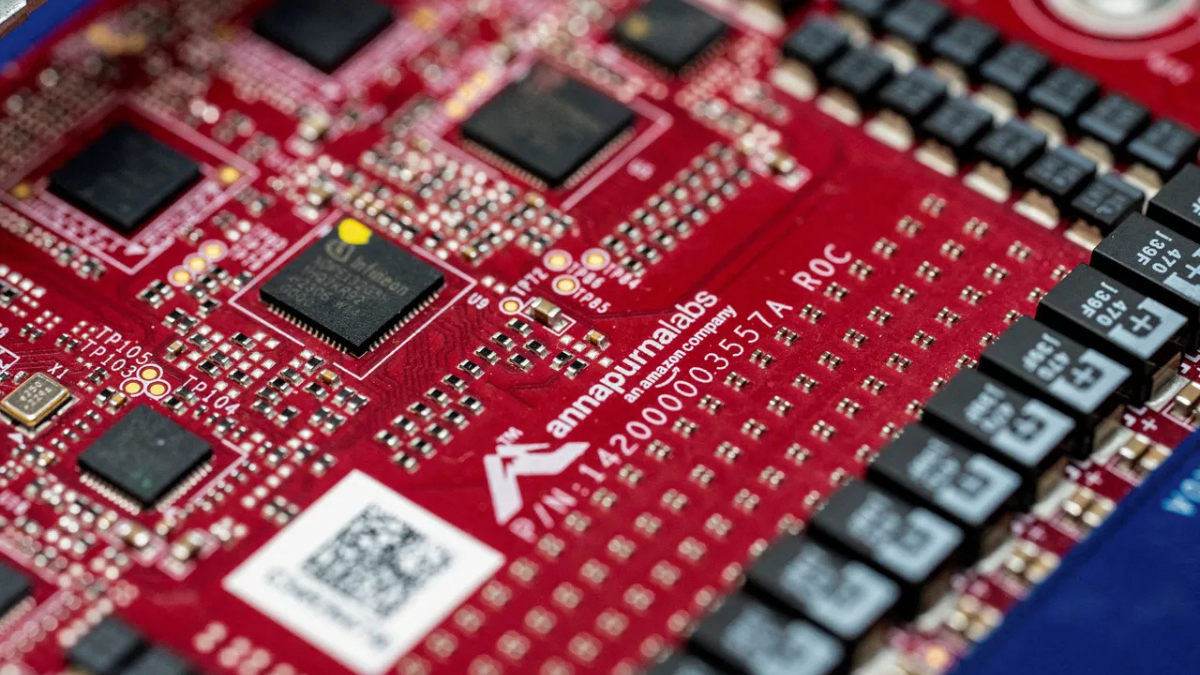
The emergence of Amazon Custom AI-chips marks a significant potential shift in the structure of the global artificial intelligence infrastructure market. For years, Amazon has developed proprietary silicon such as Trainium and Graviton primarily for internal use within Amazon Web Services (AWS). However, recent reports suggest the company may begin offering these chips to external customers, placing it in more direct competition with Nvidia’s dominant GPU ecosystem.
According to reporting from The Motley Fool and Bloomberg sources cited in the coverage, Amazon is exploring the possibility of selling its Trainium accelerators to external data center operators. This move, if fully realized, could reshape the competitive dynamics of AI compute infrastructure. The development of Amazon Custom AI-chips is therefore not just a product expansion, but a potential structural shift in how AI compute capacity is supplied globally.
At the same time, Nvidia continues to demonstrate extraordinary growth, with its data center revenue expanding rapidly despite increasing competition from hyperscalers building their own silicon solutions. This dual trend—expanding custom silicon from cloud providers alongside continued Nvidia dominance—creates a more complex and layered AI hardware ecosystem.
The Strategic Evolution of Amazon Custom AI-chips
Amazon has long invested in vertical integration within its cloud business. The development of Amazon Custom AI-chips such as Trainium, Inferentia, and Graviton reflects a broader strategy to reduce dependency on external semiconductor suppliers while improving cost efficiency across AWS infrastructure.
Historically, these chips were reserved exclusively for internal workloads. AWS customers accessed them indirectly through cloud services rather than purchasing hardware outright. However, according to Bloomberg reporting cited by The Motley Fool, Amazon is now in early discussions about offering Trainium chips directly to external buyers.
This represents a significant shift. Instead of only being a cloud provider, Amazon would also become a semiconductor vendor competing in the broader AI accelerator market. The expansion of Amazon Custom AI-chips beyond AWS could potentially influence pricing dynamics across the entire AI compute ecosystem.
“We view AI infrastructure as rapidly evolving,” Amazon AI leadership noted, emphasizing continued exploration of broader customer access.
Nvidia’s Market Position Remains Dominant
Despite growing competition, Nvidia continues to dominate the AI accelerator market. According to The Motley Fool, Nvidia’s data center revenue surged 92% year over year to a record $75.2 billion in its fiscal first quarter of 2027. This growth highlights that demand for AI compute continues to outpace supply, even as alternative hardware ecosystems such as Amazon Custom AI-chips begin to expand.
Nvidia’s strength lies not only in hardware but in its full-stack ecosystem, including CUDA software, developer tooling, and long-standing relationships with AI researchers and hyperscalers. While Amazon is advancing its chip capabilities, Nvidia retains a deeply entrenched position in AI training workloads.
Importantly, Amazon itself remains one of Nvidia’s largest customers. The company has reportedly committed to deploying more than one million Nvidia GPUs starting in 2026. This indicates that even as Amazon Custom AI-chips evolve, Nvidia’s role in powering large-scale AI infrastructure remains critical.
Cost Efficiency as the Core Competitive Driver
One of the primary motivations behind the expansion of Amazon Custom AI-chips is cost optimization. Amazon has consistently argued that Trainium-based systems can deliver comparable AI performance at significantly lower cost than Nvidia GPUs in certain workloads.
This cost advantage becomes increasingly important as AI workloads scale. Training large foundation models requires massive compute clusters, where even small differences in cost per computation can translate into billions of dollars in operational differences.
However, cost efficiency alone does not guarantee market displacement. Nvidia’s advantage lies in performance optimization, ecosystem maturity, and widespread developer adoption. As a result, the market is increasingly shaping into a multi-vendor environment rather than a winner-takes-all scenario.
Externalization of Amazon Custom AI-chips
The most significant potential development is Amazon’s consideration of selling Amazon Custom AI-chips externally. According to reporting from The Motley Fool, this would involve offering full rack-scale AI systems powered by Trainium chips to third-party customers outside AWS.
This strategy would place Amazon in direct competition not only with Nvidia but also with other hyperscalers such as Google, which has developed its own TPU chips and is also exploring limited external distribution.
If successful, this model could significantly expand the addressable market for Amazon’s semiconductor division while also increasing competitive pressure in the AI accelerator space.
Market Implications for Nvidia Investors
The rise of Amazon Custom AI-chips naturally raises questions among Nvidia investors. Increased competition from hyperscalers could introduce long-term pricing pressure in the AI accelerator market.
However, current data suggests that the overall AI compute market is expanding faster than any single supplier can dominate. Even as Amazon advances its chip strategy, Nvidia continues to grow at record levels, suggesting that demand is outpacing supply constraints across the industry.
According to The Motley Fool, the AI infrastructure market is large enough to support multiple competing architectures simultaneously. In this environment, Amazon’s entry into external chip sales may expand the market rather than directly cannibalize Nvidia’s core business in the near term.
The Role of Hyperscalers in Semiconductor Innovation
Hyperscalers such as Amazon, Google, and Microsoft are increasingly becoming semiconductor innovators. The development of Amazon Custom AI-chips reflects a broader trend where cloud providers design their own silicon to optimize internal workloads and reduce reliance on external suppliers.
This vertical integration allows hyperscalers to control cost structures, improve performance efficiency, and tailor hardware specifically for AI workloads at massive scale.
At the same time, companies like Marvell Technology play a critical behind-the-scenes role in enabling custom silicon development, further expanding the semiconductor ecosystem beyond traditional GPU manufacturers.
A Growing Multi-Chip AI Ecosystem
The AI hardware market is evolving into a multi-layered ecosystem. Rather than a single dominant architecture, multiple chip families are now coexisting and competing:
- Nvidia GPUs for general-purpose AI training
- Amazon Custom AI-chips (Trainium, Inferentia) for cost-optimized workloads
- Google TPUs for internal and selective external use
- Custom ASICs from various hyperscalers and startups
This diversification suggests that AI infrastructure demand is expanding faster than any single technology can monopolize it. The introduction of Amazon Custom AI-chips into external markets may further accelerate this fragmentation.
Long-Term Outlook for AI Compute Markets
In the long term, the expansion of Amazon Custom AI-chips reflects a broader structural transformation in computing. AI workloads are no longer confined to centralized GPU clusters but are spreading across specialized hardware platforms optimized for different use cases.
According to analysis from The Motley Fool, this trend is likely to increase overall capital expenditure in AI infrastructure rather than reduce it, as multiple competing architectures drive parallel investment cycles.
As AI adoption accelerates across industries, demand for compute resources is expected to remain strong, supporting both Nvidia and emerging competitors like Amazon.
Conclusion: Competition Expands the AI Market, Not Shrinks It
The potential external commercialization of Amazon Custom AI-chips represents a meaningful evolution in the AI hardware landscape. While it introduces new competitive pressure for Nvidia, it also signals continued expansion of the overall AI compute market.
Rather than a zero-sum competition, the current environment appears to be one of ecosystem expansion. Nvidia remains dominant, but Amazon is positioning itself as both a customer and competitor in the AI chip space.
Ultimately, the rise of Amazon Custom AI-chips reflects a broader truth: the AI revolution is large enough to support multiple hardware paradigms simultaneously, with demand growth continuing to absorb increasing supply.
Source references: According to The Motley Fool, Bloomberg reporting cited in coverage, and public earnings disclosures from Nvidia and Amazon.