


SK Hynix AI Memory Supercycle: Who Leads?
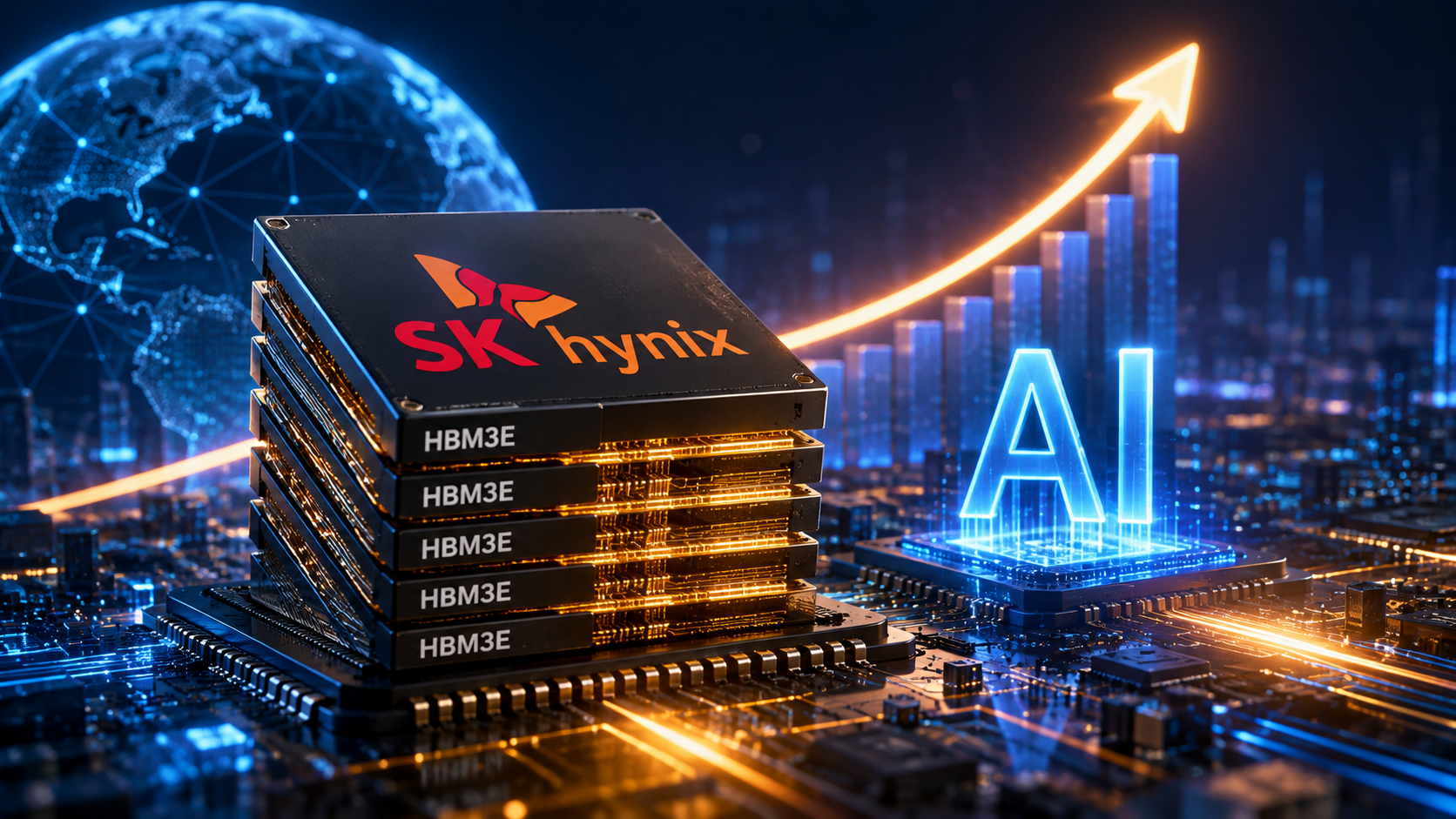
The Rise of the SK Hynix AI Memory Supercycle
The artificial intelligence boom has largely been framed as a story about compute — about GPUs, accelerators, and the companies designing them. Yet beneath the surface, a quieter but equally critical transformation is unfolding. Memory, long considered a cyclical and commoditized segment of semiconductors, has suddenly become strategic. At the center of this shift sits what can only be described as the SK Hynix AI Memory Supercycle, a phenomenon redefining how investors think about value creation in AI infrastructure.
According to The Motley Fool, the AI ecosystem does not simply rely on compute power; it relies on the ability to move and store vast quantities of data at unprecedented speeds. This requirement has elevated high bandwidth memory (HBM) into the most valuable component in the memory stack. The SK Hynix AI Memory Supercycle is therefore not just about demand, but about positioning within the most critical layer of the AI supply chain.
Why High Bandwidth Memory Matters Most
To understand the significance of the SK Hynix AI Memory Supercycle, one must first understand HBM. Unlike traditional DRAM or NAND, HBM is designed to sit close to AI accelerators, delivering ultra-fast data throughput. This proximity and speed make it indispensable for training and running advanced AI models.
In practical terms, HBM ensures that GPUs are not bottlenecked by slow data feeds. Without it, even the most powerful processors would sit idle. This is why the SK Hynix AI Memory Supercycle is closely tied to the broader AI narrative — it represents the backbone enabling compute efficiency.
- Speed: HBM delivers significantly higher bandwidth than traditional memory.
- Efficiency: Lower power consumption per bit transferred.
- Integration: Designed for close coupling with AI accelerators.
SK Hynix: Owning the Crown Jewel
The defining feature of the SK Hynix AI Memory Supercycle is the company’s dominance in HBM. With market share estimated in the high 50% range in early 2026, SK Hynix has established itself as the leader in this critical segment. More importantly, it has consistently been first to qualify new generations of HBM with major customers like Nvidia.
This leadership is not merely symbolic. In the context of the SK Hynix AI Memory Supercycle, being first translates into pricing power and superior margins. AI system builders are less sensitive to price and more concerned with securing supply. This dynamic allows SK Hynix to command premium pricing.
Being early in HBM is not just a technological advantage — it is a structural advantage that compounds over time.
The result is a company that has quietly transformed from a cyclical memory player into a strategic AI enabler. The SK Hynix AI Memory Supercycle is, in many ways, the story of this transformation.
Micron: The Challenger Gaining Ground
No discussion of the SK Hynix AI Memory Supercycle would be complete without acknowledging Micron Technology. While SK Hynix leads, Micron has emerged as a formidable challenger, capturing roughly 20% of the HBM market and surpassing competitors like Samsung.
Micron’s strength lies in its breadth. Unlike SK Hynix, which is heavily associated with HBM leadership, Micron spans the entire memory ecosystem — DRAM, NAND, and HBM. This diversification allows it to benefit from the broader SK Hynix AI Memory Supercycle while also hedging against shifts within individual segments.
- Micron’s HBM is reportedly sold out well into the future.
- It benefits from both AI-specific and traditional memory demand.
- It remains the most accessible play for U.S. investors.
Despite these advantages, the gap remains. The SK Hynix AI Memory Supercycle continues to favor the incumbent leader, though the next generation — HBM4 — could reshape the competitive landscape.
Sandisk: Riding the Storage Wave
While SK Hynix and Micron battle over compute-adjacent memory, Sandisk operates in a different arena. It focuses on NAND flash, which is essential for data storage rather than data processing. Even so, the SK Hynix AI Memory Supercycle indirectly benefits Sandisk, as AI workloads generate enormous volumes of data that must be stored.
Enterprise demand for NAND has surged, with contract prices rising sharply. Sandisk has even moved to double prices for certain high-capacity drives. This reflects the broader influence of the SK Hynix AI Memory Supercycle on the entire memory ecosystem.
However, NAND remains more commoditized than HBM. As supply increases, pricing power tends to erode. This makes Sandisk’s position within the SK Hynix AI Memory Supercycle less durable compared to SK Hynix’s dominance in HBM.
The Economics of the Supercycle
What makes the SK Hynix AI Memory Supercycle particularly compelling is its economic structure. Unlike previous memory cycles driven by consumer electronics, this cycle is driven by enterprise AI investment. That changes everything.
In the SK Hynix AI Memory Supercycle, margins are higher, contracts are longer, and demand visibility is stronger. This creates a more stable environment — at least in the short term — compared to traditional memory cycles.
Risks Beneath the Surface
Despite its promise, the SK Hynix AI Memory Supercycle is not without risks. Memory has historically been one of the most volatile segments in technology. When supply catches up with demand, prices can سقوط rapidly.
- Capacity expansion could lead to oversupply.
- Technological shifts could alter competitive dynamics.
- Macro conditions could impact enterprise spending.
The SK Hynix AI Memory Supercycle may feel structurally different, but it is still subject to these fundamental forces.
HBM4 and the Next Battlefield
Looking ahead, the next phase of the SK Hynix AI Memory Supercycle will likely be defined by HBM4. This new generation promises even higher performance and efficiency, but it also opens the door for competitors to catch up.
Micron’s progress suggests that the gap could narrow. If it successfully executes on HBM4, the balance of power within the SK Hynix AI Memory Supercycle could shift.
Investor Takeaways
For investors, the SK Hynix AI Memory Supercycle presents both opportunity and complexity. SK Hynix stands out as the current leader, with unmatched positioning in HBM. Micron offers a balanced exposure across the memory stack, while Sandisk provides a leveraged play on storage demand.
The smartest approach is not to pick a single winner, but to understand how each company fits into the broader AI memory ecosystem.
The SK Hynix AI Memory Supercycle is not a one-way trade. It is a dynamic, evolving narrative that requires careful monitoring.
Conclusion: Is SK Hynix Quietly Winning?
So, is SK Hynix quietly winning the AI memory race? In the context of the SK Hynix AI Memory Supercycle, the answer appears to be yes — at least for now. Its dominance in HBM, combined with strong customer relationships and technological leadership, places it at the top of the hierarchy.
Yet the story is far from over. The SK Hynix AI Memory Supercycle will continue to evolve, shaped by competition, innovation, and the ever-changing demands of the AI industry. For now, SK Hynix holds the crown jewel, but history suggests that in memory markets, leadership is never permanent.