



SpaceX IPO Signals a New Era for Private Space Capital
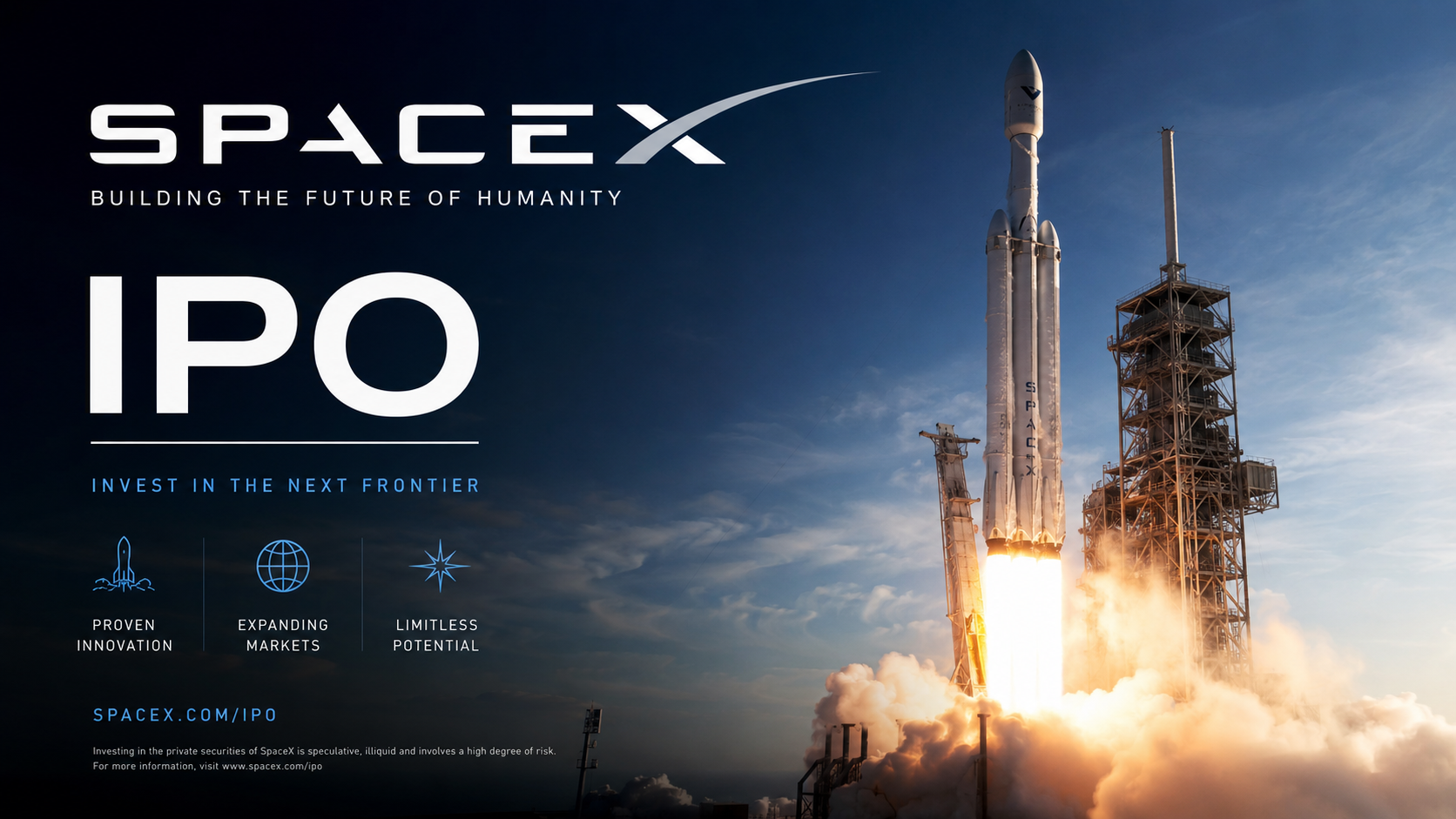
The announcement that SpaceX intends to raise $75 billion through an initial public offering has instantly become one of the most significant financial stories of the decade. According to Yahoo Finance, the proposed offering would be the largest IPO ever attempted, surpassing previous records and potentially valuing SpaceX at approximately $1.785 trillion.
For years, investors have speculated about when SpaceX would finally enter public markets. Elon Musk repeatedly resisted pressure to list the company, arguing that the long-term nature of its mission made public ownership difficult. Yet the latest filing suggests that the company now sees an opportunity to secure unprecedented levels of capital while positioning itself for its next phase of expansion.
The scale of the proposed transaction reflects more than investor enthusiasm. It highlights how SpaceX has evolved from an ambitious rocket startup into a diversified technology powerhouse with interests spanning satellite communications, launch services, artificial intelligence infrastructure, and potentially even space-based computing.
Why the SpaceX IPO Matters
The proposed IPO represents a watershed moment not only for SpaceX but also for global capital markets. According to Yahoo Finance, the company plans to offer 555,555,555 shares at $135 each, generating approximately $75 billion in proceeds.
At first glance, the fundraising figure alone is staggering. However, the deeper significance lies in what it says about investor confidence. Few companies in history have attracted the kind of attention that SpaceX commands today.
Traditionally, IPOs have been associated with companies reaching maturity. In the case of SpaceX, the situation is somewhat different. The company is not merely seeking liquidity; it is seeking fuel for another phase of aggressive expansion.
According to Yahoo Finance, SpaceX intends to use the proceeds for AI compute infrastructure, launch system improvements, satellite constellation expansion, and broader corporate initiatives.
That allocation provides insight into management's priorities. Rather than slowing down after years of growth, SpaceX appears determined to accelerate.
From Rocket Startup to Global Infrastructure Company
When Elon Musk founded SpaceX in 2002, the company was widely viewed as an extraordinarily risky venture. The commercial space industry was still relatively small, government contracts were difficult to obtain, and private launch providers faced enormous technical hurdles.
Many early critics doubted whether SpaceX could survive at all. Several launch failures nearly bankrupted the company. Yet over time, the organization transformed the economics of spaceflight through reusable rocket technology.
Today, SpaceX occupies a vastly different position.
- It operates one of the world's most advanced launch systems.
- It services government and commercial customers.
- It deploys thousands of satellites.
- It supports human spaceflight missions.
- It generates recurring communications revenue through Starlink.
The transition from launch provider to infrastructure platform has fundamentally changed how investors evaluate SpaceX. Revenue is no longer tied solely to rocket launches. Instead, the company now benefits from multiple business segments operating simultaneously.
Starlink: The Financial Engine Behind SpaceX
Any discussion about the valuation of SpaceX inevitably returns to Starlink. According to Yahoo Finance, Starlink now contributes the majority of the company's profits.
This distinction is critical.
Historically, launch businesses have struggled to achieve the consistent cash flows public investors prefer. Launch schedules can fluctuate, contracts can be delayed, and revenue streams may be uneven.
Starlink changes that equation.
The satellite internet service creates recurring subscription revenue. Every new subscriber potentially increases the predictability of future cash flow. As a result, investors may increasingly view SpaceX not merely as an aerospace company but as a communications and infrastructure business.
That shift has profound implications for valuation.
Telecommunications and technology firms often command higher earnings multiples than industrial companies. By combining aerospace capabilities with subscription-based services, SpaceX occupies a unique position that few competitors can replicate.
The AI Infrastructure Opportunity
One of the most intriguing aspects of the filing is the emphasis on artificial intelligence infrastructure.
According to Yahoo Finance, SpaceX plans to allocate a portion of IPO proceeds toward expanding AI compute capabilities.
This initiative reflects a broader trend sweeping the technology sector. AI development increasingly depends on access to massive computational resources. Companies around the world are investing billions of dollars into data centers, advanced chips, and supporting infrastructure.
For SpaceX, the strategy extends beyond traditional terrestrial facilities.
The company reportedly sees orbital computing infrastructure as a future opportunity. Elon Musk has repeatedly argued that operating certain computing workloads in space could eventually become economically attractive.
Although the concept remains largely theoretical today, the willingness of SpaceX to dedicate capital toward such initiatives demonstrates the company's long-term ambitions.
Investors are not simply funding rockets. They are funding a vision that intersects aerospace, telecommunications, artificial intelligence, and advanced manufacturing.
Terafab and the Semiconductor Ambition
Another significant development highlighted in recent reporting is the creation of Terafab, a joint venture involving Tesla and SpaceX.
The venture reportedly aims to consolidate semiconductor production under a unified framework. According to Yahoo Finance, Terafab will focus on two major chip categories:
- Edge-inference processors for Tesla's autonomous driving systems, Optimus robots, and Robotaxi operations.
- Space-hardened processors designed for satellites, orbital computing systems, and related applications.
This initiative illustrates how SpaceX is increasingly becoming part of a broader technology ecosystem surrounding Musk's companies.
The integration of semiconductor design, satellite communications, AI computing, and transportation technology creates potential synergies that traditional aerospace firms cannot easily match.
Whether Terafab ultimately succeeds remains uncertain. However, its existence reinforces the perception that SpaceX is pursuing opportunities far beyond conventional rocket launches.
The Debt Factor Investors Cannot Ignore
Despite the excitement surrounding the IPO, investors should not overlook the financial realities disclosed in the filing.
According to Yahoo Finance, SpaceX intends to use part of the proceeds, alongside debt financing, to repay portions of a $20 billion bridge loan.
This detail serves as a reminder that rapid growth often requires substantial capital.
Large infrastructure projects, satellite deployments, manufacturing facilities, and research programs consume enormous amounts of cash. Even a company as successful as SpaceX must carefully manage its balance sheet.
Fortunately for investors, debt repayment appears to be only one component of the broader capital allocation strategy. Most of the proceeds remain earmarked for expansion initiatives that could support future growth.
Elon Musk's Long-Term Vision
The proposed IPO also carries profound implications for Elon Musk personally.
According to Yahoo Finance, Musk is expected to retain substantial ownership of SpaceX even after the offering. Reports indicate he could control roughly 42% of the company before dilution.
That ownership stake matters because SpaceX is arguably the centerpiece of Musk's long-term ambitions.
While Tesla transformed the automotive industry, SpaceX represents Musk's broader vision of expanding humanity's presence beyond Earth.
Its goals include:
- Reducing launch costs.
- Building large-scale satellite networks.
- Supporting future lunar missions.
- Developing infrastructure for Mars colonization.
- Creating next-generation space transportation systems.
Many of these objectives remain decades away. Yet investors appear increasingly willing to fund projects that extend far beyond traditional corporate planning horizons.
Could SpaceX Become the World's Most Valuable Company?
The implied valuation of approximately $1.785 trillion immediately places SpaceX among the world's most valuable enterprises.
That figure naturally raises questions regarding sustainability.
Can SpaceX justify such a valuation through future earnings growth?
The answer depends on several variables:
- Starlink subscriber growth.
- Launch frequency expansion.
- AI infrastructure monetization.
- Satellite constellation profitability.
- Success of emerging ventures such as Terafab.
Investors willing to support SpaceX at this valuation are effectively betting that the company can continue creating entirely new markets rather than simply competing within existing ones.
That has been a recurring theme throughout the company's history.
The Risks Behind the Enthusiasm
No investment story is complete without acknowledging risk.
Although SpaceX enjoys remarkable momentum, several challenges remain.
- Regulatory scrutiny may increase after the IPO.
- Satellite congestion concerns continue to grow.
- Launch failures remain an inherent operational risk.
- Large-scale AI investments may require additional capital.
- Economic slowdowns could affect investor sentiment.
Furthermore, the expectations attached to SpaceX are extraordinarily high. Companies valued at nearly two trillion dollars must deliver sustained performance to justify investor confidence.
Even modest execution missteps could trigger significant market reactions.
That reality will become increasingly important once SpaceX operates under the scrutiny of public shareholders.
A Defining Moment for SpaceX and Global Markets
The planned IPO represents more than a fundraising event. It marks a pivotal chapter in the evolution of SpaceX.
According to Yahoo Finance, the company intends to raise a record $75 billion while accelerating investments in satellite infrastructure, launch capabilities, artificial intelligence, and advanced computing initiatives.
The transaction underscores how dramatically SpaceX has evolved since its founding in 2002. What began as a high-risk aerospace startup has become one of the most influential technology companies in the world.
Whether investors ultimately embrace the proposed valuation remains to be seen. Nevertheless, the scale of the offering reflects extraordinary confidence in the future of SpaceX, Starlink, and the broader ecosystem of technologies surrounding Elon Musk's vision.
For global markets, the IPO may serve as a defining test of investor appetite for ambitious, capital-intensive innovation. For Elon Musk, it represents another step toward goals that extend far beyond quarterly earnings reports.
And for SpaceX, the public listing could provide the resources needed to pursue its most ambitious projects yet—from expanding satellite connectivity across the globe to laying the foundations for humanity's future in space.