


BoJ Rate Decision: What It Means for USD/JPY
BoJ Rate Decision: What It Means for USD/JPY
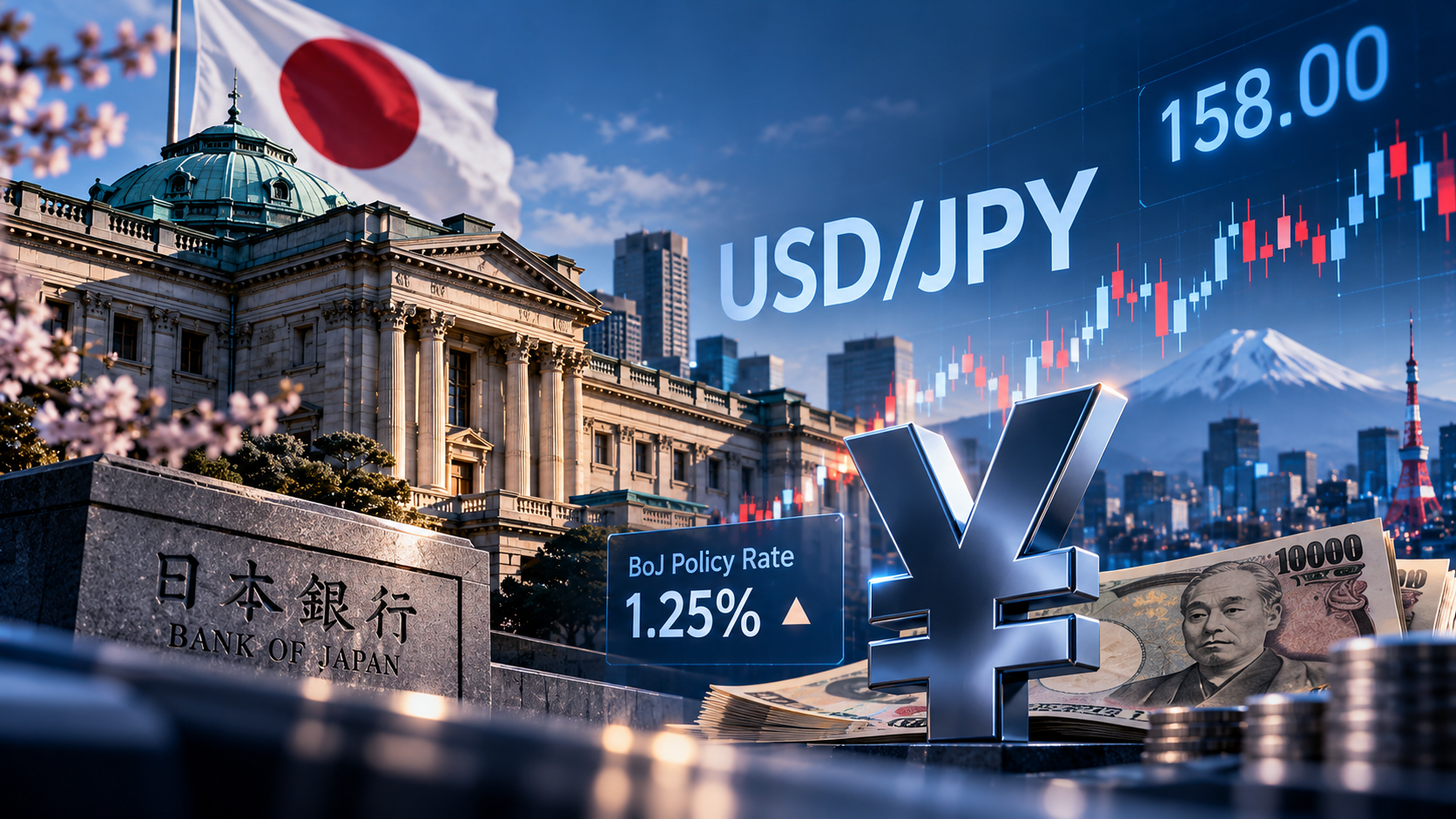
The Bank of Japan announces its October policy decision today, and the outcome is not in question. The BoJ rate decision will be a hold, with the policy rate staying at 1.25%, its highest level in 31 years. What traders are focused on is everything that comes after the rate number itself: the wording of the quarterly Outlook Report, Governor Kazuo Ueda's press conference, and what both signal about December. According to Reuters, the central bank is expected to declare that underlying inflation has broadly achieved its 2% target and flag upside price risks, language that would keep a December rate hike firmly in play. USD/JPY is trading near 158, held in place by a rate differential that a single hawkish pause will not close. With the Federal Reserve also holding at 3.75% to 4.00% just two days ago and the US 10-year yield sitting near 5%, the yen's path from here depends on how quickly that gap narrows, and on how seriously markets price the next move from Tokyo.
Why the BOJ Is Holding Today
The BoJ rate decision to hold at 1.25% reflects a central bank that has already moved quickly by its own historical standards. According to Investing.com, the Bank of Japan has raised rates by a cumulative 1.35% since early 2024, ending more than a decade of ultra-loose policy. This year alone, it has tightened by 50 basis points, hiking from 0.75% to 1.00% in June and then from 1.00% to 1.25% in September.
That September move was the one that mattered. The Bank of Japan raised its policy rate to 1.25% on September 18, a 31-year high, with markets pricing roughly an 83% probability of the hike before the announcement, according to Investing.com. The decision drew two dissents from board members who wanted either a faster pace or a different approach, highlighting that the policy committee is not unanimous. Back-to-back hikes within six weeks would represent an acceleration that the majority of the board is not ready for.
According to Reuters, at the two-day meeting ending Friday, the BOJ is maintaining its policy rate at 1.25% to spend more time scrutinising the effect of past rate hikes on lending conditions. That framing is deliberate. The BoJ rate decision language today is not about closing the door on further hikes. It is about demonstrating that the central bank is watching the transmission of previous moves before pulling the trigger again. The distinction matters for how markets read the press conference and the quarterly report.
The Bank of Japan's policy rate of 1.25% now sits within the range of 1.1% to 2.5% that its own staff estimate as Japan's neutral rate, according to Reuters. That positioning draws immediate market attention to how far the BOJ can eventually go, and whether it has room to hike without tipping into restrictive territory that might undermine Japan's still-recovering economy.
Japan's Inflation Picture and the Case for December
The data backdrop going into today's BoJ rate decision makes the case for continued tightening. Japan's core consumer price index rose to 2.1% in September, while underlying inflation reached 2.4%, according to Investing.com. Both readings sit above the central bank's 2% target, and neither shows signs of a sharp reversal.
Tokyo's core CPI for October was released this morning, just as the BOJ was wrapping up its two-day meeting. According to Investing.com, Tokyo's core inflation held above the Bank of Japan's 2% target in October, slowing only slightly from the prior month. Tokyo CPI is closely watched as an early indicator of nationwide price trends, and persistent above-target readings in the capital reinforce the argument that Japan's inflation problem has not resolved itself.
The drivers behind the stickiness are well understood. According to Investing.com, persistent price pressures in Japan have been driven partly by higher import costs stemming from yen weakness and elevated energy prices linked to the ongoing Middle East conflict. The same Middle East energy shock that is pushing European gas prices higher and complicating the ECB's job is feeding into Japanese import costs and keeping domestic inflation above the BOJ's target even as the central bank tightens.
According to Reuters, the Bank of Japan is likely to slightly revise up its next fiscal year price forecast in the quarterly Outlook Report and signal that underlying inflation has roughly achieved its 2% target. That signal carries weight. The BOJ spent the better part of 14 years trying to push inflation sustainably above 2%, and declaring that it has essentially achieved that goal is not something the policy board takes lightly. It also sets up the argument that the current rate level, still accommodative by most measures, needs to move higher to prevent an overshoot.
Such hawkish language in the quarterly report, combined with the December meeting being just seven weeks away, means the BoJ rate decision today effectively launches the market's December pricing window. Analysts cited by Reuters expect the BOJ to hike in December 2026 and again in March 2027, following a cadence of roughly one hike per quarter.
The USD/JPY Range and What's Keeping It There
Despite two rate hikes this year, the yen has not strengthened materially against the dollar. USD/JPY is trading near 158 today, and the market's response to September's hike illustrates why. According to Investing.com, USD/JPY fell from around 156.19 before the September decision to approximately 155.90 immediately afterwards, a move of less than 30 pips, before recovering toward 157 within the same session.
The reason is arithmetic. The Federal Reserve's funds rate sits at 3.75% to 4.00%. The Bank of Japan's rate is 1.25%. That is a gap of roughly 2.5 to 2.75 percentage points, and a single 25 basis point hike from Tokyo in December does not close it. Carry traders who are long USD/JPY are still earning a meaningful yield differential by holding the position, which creates structural demand for the dollar against the yen regardless of the BOJ's direction of travel.
Citi, as reported by Investing.com, expects USD/JPY to stay within a range of 155 to 160 yen per dollar in the near term, with room for a short-term rebound after recent declines in the pair. The bank notes that Japan's currency policy is becoming more hawkish, but also that the dollar is likely to remain broadly strong leading up to the US midterm elections. That combination, a hawkish BOJ facing a hawkish Fed, is why the range has held as tightly as it has through October.
"The BOJ is essentially telling markets it will hike rates once a quarter — expect December and March."
Analyst cited by Reuters, October 2026

How the Fed's Hold Complicates the Yen's Path
The Federal Reserve's October decision on October 28 added another layer to the BoJ rate decision story. The Fed held its funds rate at 3.75% to 4.00%, as expected, but the language around December left a further hike firmly on the table. According to Reuters, hawkish guidance from the Fed may reinforce expectations that the BOJ, the Fed, and the ECB will all raise rates by year-end, as brisk AI demand and the Iran war-induced energy shock worsen global inflationary pressures.
That global synchronisation of tightening is unusual and has a specific consequence for USD/JPY. When both central banks are hiking, the question is not whether Japan is tightening. It is whether Japan is tightening fast enough to close the rate differential. Based on current market pricing and analyst expectations, it is not. A 25 basis point hike from the BOJ in December, met with a similar or larger hike from the Fed, leaves the gap where it is or widens it further.
The US 10-year Treasury yield at 4.965%, just below 5%, reinforces the yield advantage the dollar holds over the yen across the curve, not just at the short end. Japanese government bond yields, even after the BOJ's tightening, remain far below US equivalents at comparable maturities. That spread sustains capital flows into dollar assets and out of yen assets, keeping the structural bid for USD/JPY alive regardless of today's BoJ rate decision.
Intervention Risk and the 160 Level
One variable that traders in USD/JPY cannot ignore is the intervention threshold. According to Citi, as reported by Investing.com, the next round of Japanese authorities buying yen is expected if USD/JPY rises above 160, with the goal of pushing the pair back below 155. The pair is currently sitting near 158, meaning there is roughly 200 pips of buffer before that level comes into play.
Japanese authorities do not intervene on a schedule or against a fixed exchange rate target. They monitor the speed and disorderliness of currency movements rather than defending a specific number. A slow grind toward 160 carries less intervention risk than a sharp move driven by a single data event or a surprise from the Fed. The BoJ rate decision press conference today, if hawkish enough, could theoretically strengthen the yen and push the pair away from that level rather than toward it.
Intervention without a narrowing rate differential is always a temporary measure. The August 2024 yen-buying operations illustrate that dynamic clearly. Authorities can slow a move or reverse it briefly, but structural carry positioning reasserts itself as long as the yield gap exists. What changes the picture more permanently is the BOJ hiking faster than the Fed, or the Fed cutting while the BOJ continues tightening. Neither scenario is on the immediate horizon.
The quarterly Outlook Report released alongside today's BoJ rate decision may carry more lasting influence on the yen than any single intervention. A report that raises the inflation forecast, flags overshoot risk explicitly, and signals a December hike is more credible than yen buying because it addresses the underlying rate differential rather than fighting it directly.

What Traders Need to Watch After the Decision
The BoJ rate decision itself lands around noon Tokyo time, which for traders in Singapore is around 11:00 AM SGT. Governor Ueda's press conference follows roughly 30 minutes later and is where the real market reaction takes shape. The sequence of events today and over the coming days:
- BoJ Statement and Rate Announcement (~11:00 AM SGT): First USD/JPY reaction. Watch for the vote count. A unanimous hold carries different weight than a split vote with one or two members pushing for a hike this meeting.
- Quarterly Outlook Report (~11:00 AM SGT): The revised inflation forecast and language around overshoot risk is the primary medium-term signal. An upward revision to the fiscal year price outlook is the confirmation that December is live.
- Governor Ueda Press Conference (~11:30 AM SGT): This is the key mover. Watch for his characterisation of how close underlying inflation is to the 2% target, his view on the pace of future hikes, and how directly he references December.
- USD/JPY technical levels: 155 to the downside as the intervention-protected floor, 160 to the upside as the intervention-trigger ceiling. A hawkish press conference could test 155. A neutral or dovish tone could let the pair drift back toward 159 to 160.
- US data this week: Thursday's US GDP first estimate and core PCE will determine whether the Fed's December hike probability ticks higher. A strong GDP print above 3.2% combined with hot PCE would widen the rate differential further and push USD/JPY away from the yen-strength scenario.
The Bigger Picture for JPY Through Year-End
Today's BoJ rate decision is not a standalone event. It is the middle chapter of a tightening story that started in early 2024 and has moved faster than most market participants expected. The Bank of Japan has raised rates by 1.35% in less than two years, ending a policy framework that held for over a decade. That pace is historically rapid for an institution that spent years defending negative rates.
According to Reuters, the central bank is now focused on preventing underlying inflation from overshooting its 2% target rather than simply reaching it. That shift in emphasis is meaningful. Targeting an overshoot risk rather than an undershoot one implies a willingness to keep hiking even as the economy adjusts. Analysts cited by Reuters describe the BOJ as entering a phase where it will raise rates once a quarter, with December and March as the next expected moves.
For USD/JPY over the remainder of 2026, the most important variable is not whether the BOJ hikes in December. It is whether the Fed does too, and whether the data supports both central banks tightening simultaneously. If the Fed skips December and the BOJ moves, the rate differential narrows and the yen can make a meaningful recovery from current levels. If both hike, the differential stays roughly where it is and USD/JPY holds its range.
Cautious language from the BOJ emphasising gradual and data-dependent tightening may allow USD/JPY to consolidate above 157. A more explicit signal from Ueda today about December would shift that equilibrium lower. Either way, the BoJ rate decision this morning is the first concrete read on where the yen trades through the end of the year, and whether December becomes the event that finally closes the gap with the dollar in any measurable way.
FAQ
Frequently asked questions
What is the BoJ rate decision for October 2026? +
The Bank of Japan held its policy rate at 1.25% at its October 29-30 meeting, as widely expected. The BoJ rate decision came with a hawkish quarterly outlook report signaling that underlying inflation has broadly reached its 2% target, leaving the door open for a rate hike as soon as December 2026.
How does the BoJ rate decision affect USD/JPY? +
The BoJ rate decision reinforced a hawkish hold, but USD/JPY remains anchored near 158 because the US-Japan rate differential stays wide. The Fed held at 3.75% to 4.00% on October 28, and with the US 10-year Treasury yield near 5%, the yen has limited room to strengthen significantly unless the rate gap narrows more quickly.
Will the Bank of Japan hike rates in December 2026? +
Analysts cited by Reuters expect the BOJ to raise rates in December 2026 and again in March 2027, following a cadence of roughly one hike per quarter. The October quarterly outlook report, which signaled that inflation has broadly reached its 2% target and flagged upside risks, reinforces the case for a December move.
What is Japan's current inflation rate? +
Japan's core consumer price index rose to 2.1% in September 2026, while underlying inflation reached 2.4%, according to Investing.com. Tokyo's core CPI for October, released on the same day as the BoJ rate decision, held above the central bank's 2% target, driven partly by yen weakness and elevated energy prices from the Middle East conflict.
What USD/JPY level could trigger Bank of Japan intervention? +
According to Citi, as reported by Investing.com, Japanese authorities are expected to intervene in currency markets if USD/JPY rises above 160 yen per dollar, with the goal of pushing the pair back below 155. The pair is currently trading near 158, leaving roughly 200 pips of buffer before the intervention threshold.
Start trading the markets you read about
Open a live or demo account in minutes
KVB Market Analysis
Latest from our insights