

Fed Rate Decision: What Markets Are Watching Today
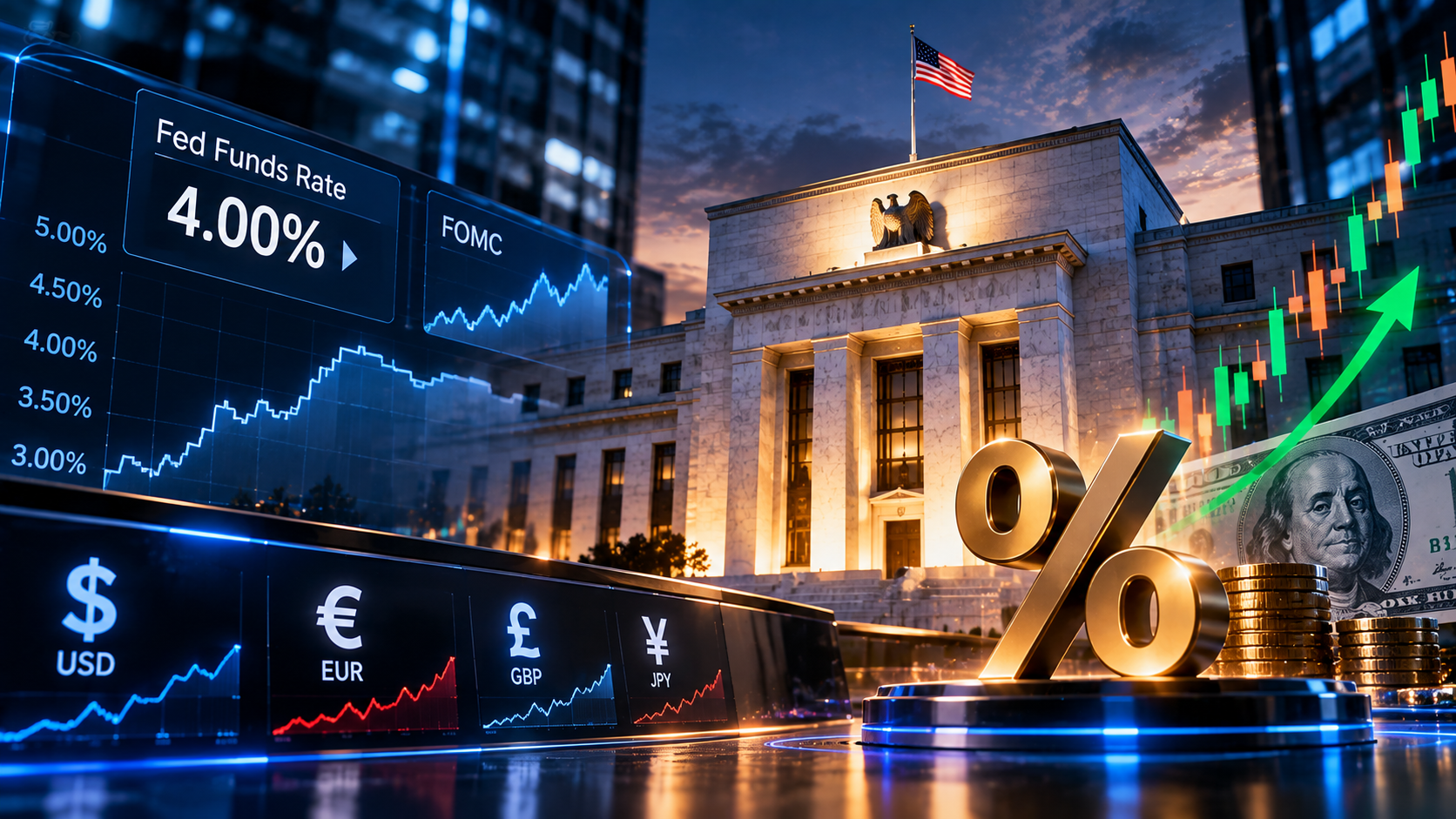
Today is one of the most closely watched sessions in financial markets this month. The Federal Reserve announces its latest interest rate decision at 2:00 PM ET, followed by a press conference from Chair Kevin Warsh at 2:30 PM ET. Markets are not expecting a hike. The Fed funds rate currently sits at 4.00%, and the CME FedWatch tool shows a 91% probability it stays there. But the decision itself is almost beside the point. What traders are focused on is the language in the FOMC statement and Warsh's tone at the press conference — specifically what both signal about December, where Fed rate decision markets are already pricing a hike probability of 84% to 87%. Meanwhile, the dollar is at a two-week high, the 10-year Treasury yield is sitting near 5.00%, and Microsoft and Alphabet both report earnings after the US close. Wednesday, October 28 is carrying a lot of weight in one session.
Why the Fed Is Expected to Hold
The Federal Reserve raised rates by 25 basis points in September, moving the target range from 3.50%–3.75% to 3.75%–4.00%. According to Investing.com, that September hike ended a prolonged pause, and policymakers cited elevated inflation while describing economic activity as expanding at a solid pace. The October decision was always expected to be a hold. Two consecutive hikes within six weeks would represent a material change in the Fed's operating rhythm, and there has been no data shock since September that would force that kind of acceleration.
The CME FedWatch tool's 91% probability of no change today is as close to certainty as futures markets ever get for these events. That near-certainty is exactly why the Fed rate decision markets reaction will be driven by what comes after 2:00 PM, not by the rate announcement itself. The binary outcome traders are watching is not hold versus hike. It is hawkish hold versus neutral hold.
Chair Warsh has neither endorsed nor pushed back on colleagues' recent signals to wait for more data before moving again, according to Yahoo Finance. That deliberate ambiguity ahead of today's meeting has itself been a form of forward guidance. It tells markets that December is genuinely open and that Warsh is not willing to pre-commit either way. For forex traders and equity positioning, that ambiguity maintains the risk premium in USD and keeps yields from rallying back down.
Economic data supports the case for holding now while preserving the option to move in December. The Chicago Fed National Activity Index printed at +0.07 for September, pointing to modestly above-trend growth. That is not the kind of reading that demands an emergency hike. But it is also not a weakening economy that gives the Fed reason to stand down. The backdrop is a resilient economy still running above trend with inflation that has not returned to target, which is precisely the environment that keeps December live.

What the Dollar Is Telling You
The dollar's pre-meeting positioning has been telling. According to Reuters, the US dollar index rose 0.3% on Tuesday to 102.40, reaching its highest level since October 14. That is not a dramatic move, but it reflects a clear and steady repositioning by currency markets in anticipation of a hawkish tone from Warsh. Traders are not waiting for the statement to decide where the dollar goes. They are already leaning into it.
Against specific pairs, the euro held flat at $1.1129 and the British pound was unchanged at $1.3307, according to Reuters reporting from Singapore ahead of the Asian session. USD/JPY was marginally firmer around 157.81 to 158.03 yen. The yen's movement has been complicated by ongoing speculation about Bank of Japan intervention, but the broad dollar strength is not about Japan in isolation. It reflects a global currency market that has accepted the Fed will stay restrictive for longer than it expected six months ago.
One analyst from Pepperstone in Melbourne summed up the Fed rate decision markets dynamic precisely, as quoted by Reuters: the Fed does not need to hike today to move markets. It simply needs to change the perceived probability of hiking in December. That observation frames the entire session. A hold with hawkish language is not the same as a hold with neutral language. The dollar's reaction over the following hour after 2:00 PM ET will almost entirely be a function of whether that language shifts.
For traders holding USD pairs, the specific statement language to watch is whether the FOMC retains wording about additional tightening being appropriate, softens it toward data-dependence language, or adds explicit reference to upcoming readings as the decisive inputs. Each of those outcomes carries a meaningfully different implication for where EUR/USD, GBP/USD, and USD/JPY trade through Thursday and Friday.
Treasury Yields and the Rate Signal
The 10-year Treasury yield heading into today's decision is sitting near 5.00%, according to Investing.com. The 2-year yield is at 4.68%. After months of inversion, the spread between the two has been narrowing, and the current shape of the curve reflects a market that has largely accepted rates will be higher for longer. The 10-year holding above 5.00% is not a new story, but it remains a structurally significant level for every asset class that prices off it.
A 5% 10-year yield raises the hurdle rate for equity investments, corporate refinancing, and leveraged positions. It puts a real cost on the AI infrastructure buildout that has defined the tech narrative in 2026. It also keeps a floor under the dollar by widening the interest rate differential between the US and most major economies. The Bank of Japan meets Thursday and the ECB met last week, but neither is anywhere near the Fed's current rate level, which sustains the yield advantage that has been supporting the greenback.
The Fed rate decision markets week extends beyond Wednesday. Thursday's calendar brings the Q3 GDP first estimate, where consensus sits at 3.2% and the Atlanta Fed GDPNow model is running at 3.5%. It also brings September core PCE, the Fed's preferred inflation gauge, where economists expect a 0.3% monthly print after 0.2% previously. University of Michigan survey data already pegs year-ahead inflation expectations at 4.7% for October, a five-month high, according to Yahoo Finance. If Thursday's data confirms that inflation is re-accelerating and growth remains above trend, December hike odds will move materially higher and the bond market will respond before US equity markets open.

Microsoft, Alphabet, and the AI Spending Question
After the Fed press conference closes the afternoon session, the market shifts to two of the most consequential earnings reports of the season. Microsoft and Alphabet both report third-quarter results after the US close on Wednesday, according to Yahoo Finance. The primary variable in both reports is AI capital expenditure — how much each company is spending on data centres, chips, and cloud infrastructure, and whether revenue from AI workloads is growing fast enough to justify it.
This is where the Fed rate decision markets trade and the earnings trade collide in the same session. Higher rates do not make AI infrastructure spending impossible, but they raise the real cost of financing it. Microsoft and Alphabet are spending at a pace that would have seemed extraordinary even three years ago. They are doing so in an environment where the 10-year Treasury yield is near 5.00%. That is not a fatal constraint, but it is a real one that the market is paying closer attention to in 2026 than it was in 2024 or 2025.
According to Yahoo Finance, big AI projects at Microsoft, Amazon, and others require heavy data centre and chip spending, which feels more uncomfortable when Fed rate expectations creep higher and borrowing stays expensive. That framing captures the tension exactly. If Warsh delivers a hawkish hold at 2:30 PM ET and then Microsoft guidance implies capex is rising again without a proportional increase in AI revenue, the two events compound into a risk-off move in tech. If Warsh is more neutral and Microsoft beats on both revenue and margin, the two events compound in the opposite direction.
The earnings reports will not be available to digest until Asian markets are already several hours into Thursday's session. Traders in Singapore and across the region will be watching futures overnight for the first read on how the combined Fed and earnings outcome lands in US markets before their own open.
How Asian Markets Are Setting Up
Asian stock markets rose broadly on Wednesday morning, tracking gains from Wall Street's Tuesday session. Semiconductors and data-centre related names were the primary outperformers, with South Korean and Japanese names tied to the AI buildout leading regional gains. The move reflected continued optimism around technology earnings and sustained AI infrastructure demand heading into the US earnings reports after the close.
The broader Asian session on Wednesday is a holding pattern. Regional markets are processing Tuesday's Wall Street gains while waiting for the Fed rate decision markets outcome to land in the overnight US session. The real re-pricing for Asia comes Thursday morning, when traders return to the full picture: the Fed statement and press conference, the Microsoft and Alphabet earnings, and the Thursday GDP and PCE data that will arrive before most Asian markets close for the day.
Japan adds one more variable. The yen is trading near 158 per dollar, a level that has historically drawn speculation about intervention from Japanese authorities. Bank of Japan Governor Ueda meets on Thursday, and the combination of a potentially hawkish Fed and any BoJ language about yield curve control adjustments will put USD/JPY under particular scrutiny for the remainder of the week.
What Traders Need to Watch and When
Today's session runs on a tighter timeline than most Fed days, given the earnings schedule sitting behind it. The following sequence is what the Fed rate decision markets reaction will be built around:
- 2:00 PM ET — FOMC Statement: First market reaction in USD, gold, and equity futures. The specific language on inflation and additional tightening is the read, not just the rate number.
- 2:30 PM ET — Warsh Press Conference: The primary market mover. Watch for his characterisation of December, his response to questions about inflation expectations, and whether he pushes back on the current level of market pricing for year-end rates.
- After US Close — Microsoft (MSFT) and Alphabet (GOOGL) Earnings: AI capital expenditure and forward revenue guidance are the numbers that matter. Both companies have been among the heaviest spenders on AI infrastructure in 2026.
- Thursday 8:30 AM ET — GDP and Core PCE: These two data points will determine whether the December hike debate is settled or extended further. A hot PCE above 0.3% combined with GDP at or above 3.2% makes December a near-certainty.
For active traders, the pairs and instruments with the most direct exposure to today's events are EUR/USD, GBP/USD, USD/JPY, spot gold, Nasdaq 100 futures, and US 10-year Treasury futures. Each one carries a different sensitivity profile to the Fed versus earnings outcome, and positioning across all of them will reset multiple times between the FOMC statement and Thursday's close.
"The Fed doesn't need to hike today to move markets. It simply needs to change the perceived probability of hiking in December."
Chris Weston, Head of Research, Pepperstone, as reported by Reuters
The Bigger Picture Heading Into Year-End
Today is the second-to-last FOMC meeting of 2026. The final meeting is scheduled for December 8-9. Between now and then, the Fed will have access to two more months of employment data, another CPI and PCE reading, and the Q3 GDP revision. That is a reasonable amount of data to work with before making a year-end decision. It is also enough data to flip the December outcome if any of it surprises materially in either direction.
The market's current positioning, an 84% to 87% probability of a December hike, is a high bar. It means markets have already largely decided December is a hike unless the data falls apart. Warsh's job today is not to confirm or deny that reading outright, but to calibrate it. If he suggests the bar for December is data-dependent and emphasises risks on both sides, those odds could pull back. If he adopts the tone of someone who has already decided and is simply waiting for confirmation, they could push higher still.
The Fed rate decision markets reaction today will also be read in the context of what has happened globally. The Bank of England meets Thursday, the ECB has already moved, and the Bank of Canada is also deciding this week. Central bank coordination across major economies is not explicit, but the directional bias globally remains restrictive. The December hike would reinforce that global trend. A pause beyond December would be the first sign of a genuine pivot in the tightening cycle, and the market is not priced for that outcome at all.
According to Investing.com and Yahoo Finance, today's session packs the Fed decision, the most important technology earnings of the season, and a setup for Thursday's macro data all into one compressed window. Chair Warsh's words at 2:30 PM ET begin the sequence. The Fed rate decision markets reaction that follows will set the tone for how the final two months of 2026 trade across every major asset class. The question of whether December becomes a hike or a hold is still technically open. What Warsh says this afternoon is the first real answer.
FAQ
Frequently asked questions
What is the Fed rate decision for October 2026? +
The Federal Reserve is widely expected to hold its benchmark rate unchanged at 3.75% to 4.00% at its October 27-28 meeting. CME FedWatch shows a 91% probability of no change. The focus shifts to Chair Warsh's press conference and what he signals about a potential December hike, where market odds currently sit between 84% and 87%.
How does the Fed rate decision affect forex markets today? +
The US dollar index rose to 102.40 ahead of the decision, a two-week high. EUR/USD is flat at $1.1129, GBP/USD at $1.3307, and USD/JPY near 158. A hawkish hold, where the Fed keeps rates unchanged but signals December is live, would likely extend dollar strength. A neutral or softer tone could trigger a pullback across USD pairs.
Will the Fed hike rates in December 2026? +
Fed funds futures are pricing an 84% to 87% probability of a rate hike at the December 8-9 meeting. The key inputs between now and then are Thursday's Q3 GDP first estimate, September core PCE data, and Chair Warsh's tone at today's press conference. A strong GDP print combined with core PCE above 0.3% would reinforce the December hike case significantly.
What does today's Fed decision mean for Treasury yields and gold? +
The 10-year Treasury yield is sitting near 5.00% ahead of the decision. Gold is sensitive to real yields and will react quickly to any shift in Fed language. A hawkish hold that reinforces December hike expectations would likely keep yields elevated and apply downward pressure on gold. A softer statement could trigger a bond rally and a gold move higher.
When does the Fed announce its rate decision today? +
The FOMC statement is released at 2:00 PM ET on Wednesday, October 28, 2026. Chair Warsh's press conference follows at 2:30 PM ET. For traders in Asia, that is 3:00 AM SGT (Thursday morning) for the statement and 3:30 AM SGT for the press conference.
Start trading the markets you read about
Open a live or demo account in minutes
KVB Market Analysis
Latest from our insights