



Big Banks Kick Off Q2 Earnings as CPI Data Collides
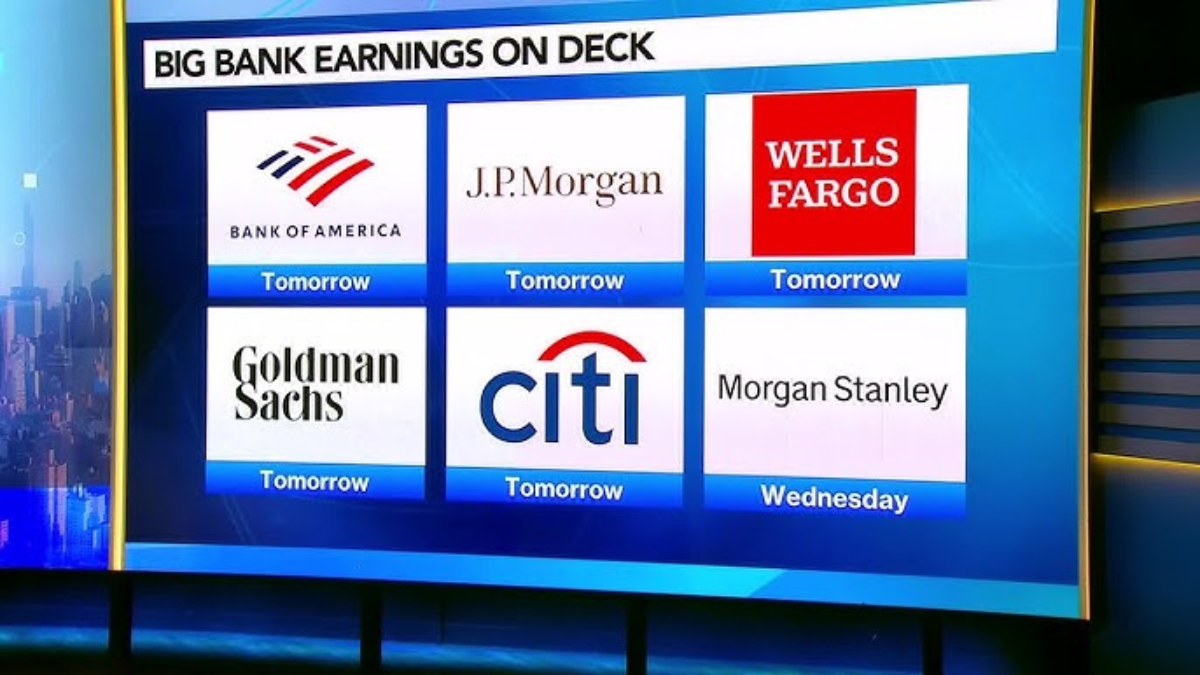
Tuesday marks one of the most concentrated mornings in recent Wall Street memory: JPMorgan Chase, Goldman Sachs, Bank of America, Citigroup, and Wells Fargo are all releasing second-quarter 2026 results before the opening bell, at the exact moment the Bureau of Labor Statistics drops its June Consumer Price Index reading. The rare double print effectively marks the unofficial start of earnings season and gives investors an unusually dense set of signals to parse in a single trading session.
A Crowded Pre-Market Session
The simultaneous reporting schedule is itself notable. According to CNBC, JPMorgan Chase, Goldman Sachs, Bank of America, Citigroup, and Wells Fargo are all scheduled to report before the market opens Tuesday, marking the unofficial start of the US earnings season. That every major money-center bank reports on the same morning as a closely watched inflation print creates what one analysis called a potential "volatility cocktail," since traders must simultaneously digest bank-specific results and a macro data point that could reshape Federal Reserve rate expectations.
Options markets are already pricing in outsized moves. Implied volatility ahead of the print points to expected single-session swings ranging from 4.4% for JPMorgan up to 6.0% for Goldman Sachs, with Citigroup and Wells Fargo both priced around 5.5% and Bank of America near 4.5%. Those figures reflect genuine uncertainty about how the combination of earnings and CPI data will move bank stocks, rather than a purely mechanical beat-or-miss reaction.
What to Watch
Net interest margin (NIM) trajectory — more important than headline EPS this quarter
Credit quality metrics and loan-loss provisions
Investment banking and trading revenue, tied to a recovering M&A and IPO pipeline
Management commentary on the economic outlook amid Fed policy uncertainty
Why Net Interest Margin Is the Real Story
Analysts covering the sector argue that investors should focus less on whether these banks beat consensus EPS estimates — described as a near-certainty given conservative guidance — and more on net interest margin trajectory and forward-looking commentary. Net interest margin reflects the spread between what banks earn on loans and investments versus what they pay out on deposits, and with the Federal Reserve's rate path uncertain, that spread will determine whether the sector can sustain the profitability growth it has posted in recent quarters.
With the Fed on hold and a relatively stable rate curve, consensus expectations point to net interest margin holding in a range of roughly 2.7% to 2.9% across the group. Additional compression beyond that range would hit what has historically been the most predictable component of bank earnings, and would likely draw a more negative market reaction than a modest EPS miss.
Consensus Estimates Heading Into the Print
For the finance sector as a whole, total Q2 earnings are expected to increase roughly 12.6% year over year on higher revenues, according to sector-wide estimates compiled ahead of the reporting window. Individual bank projections vary meaningfully: Wells Fargo's consensus points to EPS growth near 12.3% on revenue growth of about 4.7%, while JPMorgan, Bank of America, and Citigroup EPS are expected to rise 11.3%, 27%, and 38.8% respectively from the same quarter a year ago.
JPMorgan Chase specifically enters the print with Wall Street modeling earnings per share in the high-$5 range, with some estimates as high as $5.67 and others closer to $5.52, alongside projected revenue in the $48.7 billion to $51.1 billion range — a spread that itself illustrates how much uncertainty remains even for the sector's best-covered name. The bank has an established track record of topping expectations, having beaten the Zacks Consensus Estimate in each of its trailing four quarters, with an average beat of roughly 7.36%.
The most likely outcome is that the results confirm the constructive trend rather than upend it.
Bull and Bear Cases Heading Into the Season
The constructive case for the sector rests on a combination of resilient loan demand, a rebound in capital markets activity, and improving trends in mergers, acquisitions, and initial public offerings after two comparatively weak years. Goldman Sachs and, among Wednesday's reporters, Morgan Stanley are seen as the biggest beneficiaries if management commentary confirms a healthy pipeline of deal activity heading into the back half of the year, while JPMorgan benefits additionally through its large trading and markets division.
- Bull case: JPMorgan and Bank of America post flat net interest margin with no increase in credit-loss provisions, Goldman Sachs and Morgan Stanley confirm a healthy M&A pipeline, and the sector rallies 3–5%, dragging the KBW Bank Index higher alongside a positive read-through for regional banks
- Base case: moderate EPS beats with net interest margin compressed by 5 to 10 basis points and provisions roughly stable, producing a mixed, stock-specific reaction and a sector move within plus-or-minus 1%
- Bear case: a negative surprise on credit-loss provisions or cautious commentary on commercial real estate exposure, sending the sector down 4–6% with contagion risk to regional banks and a rotation into perceived safe havens like gold and government bonds
The bear case for the group centers on a flatter yield curve squeezing margins, still-sluggish mergers-and-acquisitions activity in certain segments, and lingering questions around private-credit exposure. Wells Fargo's own trimmed estimates ahead of the print serve as a reminder that not every lender in the group is moving in the same direction, even within a broadly constructive earnings season.
The CPI Overlay
The timing collision with the June Consumer Price Index report adds a second, macro-driven layer to Tuesday's trading. Economists broadly expect headline inflation to have cooled somewhat in June, yet that expectation has not stopped bond traders from raising the odds they assign to a Federal Reserve rate hike at the July 28–29 policy meeting — a dynamic that has been reinforced by this week's spike in oil prices tied to the Strait of Hormuz blockade and the associated energy-driven inflation risk.
That combination — bank earnings that hinge on net interest margin assumptions, and a CPI print that could shift the market's read on Fed policy in either direction — is precisely why options markets are pricing elevated volatility into Tuesday's session. A hotter-than-expected inflation print paired with softer bank guidance on margins would compound negative sentiment, while a cooler CPI reading alongside solid bank commentary could reinforce the more constructive scenario analysts have sketched out for the sector.
Why Banks Matter as a Bellwether
Market strategists have long treated bank earnings as an early barometer for the broader economy, since lenders' results reflect consumer demand, business investment, and capital markets conditions across a wide swath of industries simultaneously. Aggregate industry data ahead of Tuesday's print suggested the group could report its best loan growth numbers in almost three years, which — if confirmed in the actual results — would offer a reassuring signal about underlying credit demand even amid the geopolitical and inflation headwinds dominating headlines this week.
The finance sector is also the second-largest earnings contributor to the S&P 500, trailing only technology, meaning Tuesday's results carry weight well beyond the bank stocks themselves. A confirmed pattern of resilient net interest margin and stable credit quality across the five reporting banks would likely support the broader market's earnings-driven bull case, which strategists note has been the primary driver of the S&P 500's gains this year rather than multiple expansion.
What Comes Next
- Wednesday brings a second wave of bank earnings from Morgan Stanley, Bank of America, and Goldman Sachs alongside additional inflation data
- Investors will watch whether management teams raise or trim full-year net interest margin guidance on earnings calls
- Analysts will parse trading and investment-banking revenue for signs of a sustained capital-markets recovery
- The CPI print's effect on Fed rate-hike odds will be tracked through CME FedWatch pricing over the following days
- Broader Q2 earnings season continues later in the week with reports from Netflix, Johnson & Johnson, UnitedHealth Group, and United Airlines
With nearly 70 companies reporting this week, including 29 S&P 500 members, Tuesday's bank results are just the opening act of a reporting season that strategists expect to show a second consecutive quarter of earnings growth above 20% for the broader index — a run that has so far been led disproportionately by the technology sector, with financials now getting their turn to confirm or complicate that narrative.
A Sector Backdrop Shaped by Falling Geopolitical Risk
Heading into Tuesday's print, some of the geopolitical risk that had previously weighed on bank stocks had eased, and that easing had already fed through into both share prices and analyst estimates. JPMorgan shares, for instance, had gained roughly 4% year-to-date ahead of the print, while the broader group has had what analysts describe as a decent, if unspectacular, run through the first half of 2026. Keefe, Bruyette & Woods analyst Christopher McGratty raised his price target on JPMorgan shares to $370 from $363 ahead of the report, citing improving fundamentals and what he called attractive valuations continuing to support bank stocks more broadly.
That relative calm, however, was upended almost immediately by the weekend's renewed US-Iran hostilities and Monday's Strait of Hormuz blockade announcement, which reintroduced a fresh source of macro volatility just as the sector prepared to report. Bank stocks therefore enter Tuesday's session navigating two separate narratives simultaneously: an idiosyncratic, fundamentals-driven earnings story, and a broader risk-off impulse tied to oil prices and inflation expectations that has nothing to do with any individual lender's loan book.
How Wall Street Is Positioned Ahead of the Results
Sell-side sentiment heading into the print skews constructive but not uniformly so. Coverage from TipRanks notes that Wall Street currently sees the biggest price upside among the group in Wells Fargo, even though that stock carries only a Moderate Buy consensus rating rather than a more emphatic recommendation. Average price targets across the five reporting banks imply upside in the range of roughly 11%, according to data compiled ahead of the results, though that average masks considerable dispersion between the most and least bullish analyst calls.
Elsewhere in the market, early-reporting companies have already offered some read-through on the broader earnings backdrop. Of the roughly 18 S&P 500 members that had reported results heading into this week — companies with fiscal quarters ending in May, counted toward the June-quarter tally — aggregate earnings were running about 143% higher year over year on revenue gains near 24%, with close to 89% beating EPS estimates and roughly 78% beating revenue estimates. Analysts caution against drawing firm conclusions from that small early sample, but it does suggest the broader corporate reporting backdrop remains favorable as the banks take center stage.
Regional and Global Ripple Effects
Because JPMorgan, Bank of America, and to a lesser extent Citigroup carry meaningful retail banking exposure, their commentary on consumer credit health is likely to be closely parsed by investors in regional bank stocks reporting later in the season. A confirmed pattern of resilient consumer spending, low delinquency rates, and steady loan growth would likely be read as broadly supportive for the KBW Regional Banking Index, whereas any signs of stress in consumer credit — particularly in categories like auto loans or credit cards — could prompt a more cautious re-rating across smaller lenders with less-diversified balance sheets.
Globally, the results also carry implications beyond US markets. European and Asian banks with significant capital-markets or correspondent-banking relationships with the reporting US institutions often see their own shares trade in sympathy with strong or weak commentary from JPMorgan and Goldman Sachs in particular, given both firms' scale in global trading and underwriting activity. A confirmed rebound in investment-banking fees, if it materializes in Tuesday's results, would likely be viewed as a positive read-through for European investment banks and asset managers navigating a similarly uncertain rate environment.
The Basel III Capital Overhang
One recurring theme investors are watching for in management commentary is the potential capital impact of proposed Basel III and global systemically important bank, or G-SIB, regulatory changes. Prior disclosures from JPMorgan's own earnings calls have flagged that the proposed capital framework could require meaningful incremental capital and put modest pressure on common equity tier 1, or CET1, ratios — a dynamic that could constrain the pace of share buybacks and dividend growth if regulators proceed with stricter requirements. Any fresh guidance on this front, positive or negative, is likely to move bank stocks independently of the quarter's actual reported profitability.
Management teams have also previously flagged regulatory and cybersecurity risk tied to artificial intelligence adoption within their own operations as an area that could constrain returns or growth in specific business lines. Given how central AI infrastructure spending has become to the broader market narrative this year, any commentary from bank executives on how they are budgeting for AI-related technology investment, or on emerging operational risks tied to AI systems, could draw outsized attention on Tuesday's earnings calls even though it sits outside the traditional net-interest-margin and credit-quality framework analysts typically focus on.
Bottom Line for Investors
Tuesday's results won't just answer whether five of the largest US banks beat a consensus EPS number that most analysts already view as a low bar to clear. They will offer the clearest read yet on whether net interest margins can hold in their expected 2.7% to 2.9% range even as the Fed's next move remains genuinely uncertain, whether the recovery in dealmaking and trading activity that strategists have been anticipating all year is actually showing up in the numbers, and whether consumer credit remains healthy enough to support continued loan growth heading into the second half of 2026. Layered on top of a fresh oil-price shock and an inflation print that could reshape rate expectations within hours, it is a session investors are unlikely to treat as routine. According to CNBC, Zacks Investment Research, TipRanks, IG, and the American Bazaar.