


Fed December Rate Hike: What PCE Data Means
Fed December Rate Hike: What Today's PCE Data Means for Traders
Today is the most important data day of the month for traders watching the Fed December rate hike. The US Bureau of Economic Analysis releases its second estimate of Q3 2026 GDP and the October PCE inflation report at 8:30pm Malaysia time. Markets have already priced a 91% probability of a quarter-point hike at the Federal Reserve's December 9 meeting, according to CME Group's FedWatch tool. The question is not whether the hike happens. The question is what today's data does to the path after December.
The US Dollar Index has climbed to 103.66, its highest level in 19 months, driven entirely by Fed December rate hike expectations. Gold hit a 14-month low before staging a partial recovery. EUR/USD dropped to a 19-month low of $1.0985. The Australian dollar hit a 10-month low. These are not minor moves at the margin. This is a broad, sustained repricing of global assets around a single macro driver: the belief that the Federal Reserve will keep tightening into the end of 2026, and possibly into 2027.
This article breaks down what the data says, what traders should expect from the PCE print, and what a hot or soft reading means for the USD, gold, and risk assets across the region.
Why the Fed December Rate Hike Is Already Priced In
The path to near-certainty on the Fed December rate hike was built over several weeks. It started with the September PCE reading, which showed headline inflation rising to 3.6% year-over-year, well above the Fed's 2% target. That was followed by a hotter-than-expected October CPI report, which pushed December hike odds from 73% to above 90% in a single session, according to Reuters.
Fed officials have been explicit. Fed Governor Christopher Waller said he would support a quarter-point hike at the December meeting regardless of what the PCE report showed. Dallas Fed President Lorie Logan went further, indicating that more aggressive rate hikes may be necessary to bring inflation under control. Those two statements, taken together, left little room for the market to price anything other than a hike.
The Federal Open Market Committee held rates at the 3.75%–4.00% range at its October 28 meeting in a 10-2 vote. The two dissenting members favored a hike at that meeting. That vote composition matters: it signals that the internal pressure for further tightening is real, and that the December decision is not a close call inside the committee.
Oxford Economics, in a November 16 briefing, stated that "broadening pressures lock in December rate hike" and warned that markets were overpricing the odds of a 50-basis-point move. The base case across most major institutions is 25 basis points on December 9. The tail risk is a half-point hike if today's PCE print surprises to the upside.

What the Q3 GDP Revision Tells Us
The first piece of today's data release is the second estimate of Q3 2026 GDP. The advance estimate published on October 29 showed the US economy growing at a 3.4% annualized rate, beating the consensus forecast of 3.2%. Personal consumption grew at 3.8%. Real final sales to private domestic purchasers rose at their fastest pace since Q2 2021.
Inside the GDP report, the inflation picture was more nuanced. The GDP PCE price index slowed to 2.09% annualized in Q3, down sharply from 5.01% in Q2. Core PCE inside the GDP report came in at 2.47% annualized. Those are the quarterly averages. The monthly September PCE reading, released separately, told a different story: headline PCE rose 3.6% year-over-year in September, the highest reading since early 2026.
The second GDP estimate today will revise those Q3 figures. Any upward revision to growth strengthens the Fed's case for the Fed December rate hike, since robust economic expansion reduces the risk that further tightening pushes the economy into contraction. A downward revision would be more complex: it could soften the dollar slightly, but it is unlikely to change the December call given how firmly it is already priced.
According to BabyPips, both the GDP revision and the October PCE report were scheduled to drop simultaneously today, making this one of the most data-heavy pre-holiday sessions in recent months.
What the PCE Print Could Do to Markets
The October PCE inflation number is the more market-moving release today. Core PCE for October is expected to remain elevated. The September monthly PCE read came in at 0.5% month-on-month, its biggest jump since March, according to Trading Economics. If October prints in the same range, the dollar gets another leg higher, gold faces renewed selling pressure, and the small probability of a 50-basis-point hike grows.
If the October PCE comes in softer, the market reaction is less obvious but potentially more interesting. The Fed December rate hike itself does not get repriced off one soft monthly print. 91% probability does not move much lower based on a single data point. What shifts is the language around 2027. A softer PCE opens the door to a pause after December, which would weaken the dollar and give gold room to recover.
According to Investing Live, traders are pricing roughly 84% odds of the December hike remaining unchanged even after the Fed's rate decision. The more sensitive variable is the December meeting statement and what it signals about January 2027. That forward guidance, more than the December hike itself, is what the data today will shape.
The two-year Treasury yield, which tracks Fed rate expectations most directly, was last seen near 4.835%, up over 10 basis points on the session before the data. That level reflects a market that has fully absorbed the Fed December rate hike and is now pricing the possibility of additional moves in early 2027.
The US Dollar Index at 19-Month Highs
The US Dollar Index climbing to 103.66 is not a gradual drift. It is a directional move built on a clear macro narrative. As Reuters reported, the dollar hit a 19-month high as hotter-than-expected inflation data and hawkish Federal Reserve signals convinced traders that the central bank will continue tightening. The euro fell to $1.0985, sterling dropped to $1.3172, and the Swiss franc reached an 18-month low of 0.84075 against the dollar.
For traders in Southeast Asia, this dollar strength has direct consequences. USD/JPY has been a focal point, with the yen under pressure as the Bank of Japan maintains its accommodative stance while the Fed tightens. AUD/USD hit an eight-month low, reflecting the dual pressure of a strong dollar and risk-off sentiment around AI stocks and global growth concerns.
The Fed December rate hike is not priced in isolation. It is priced as part of a tightening cycle that markets now believe extends into 2027. Dallas Fed President Logan backed at least two further 25-basis-point increases beyond December. If that path holds, the dollar's current 19-month high may not be its peak.
The practical implication for forex traders is that USD pairs remain directionally biased toward dollar strength until the data or Fed communication changes. Any softer-than-expected PCE print today creates a short-term tactical opportunity on the other side, but it does not reverse the medium-term trend as long as inflation stays above 3% and the Fed signals continued tightening.
What This Means for Gold
Gold fell nearly 3% in a single session after the October CPI data reinforced Fed December rate hike bets, dropping below $4,050 an ounce. The metal subsequently hit a 14-month low, down roughly 9% over the prior week, before dip-buyers stepped in and pushed it back toward $3,600.
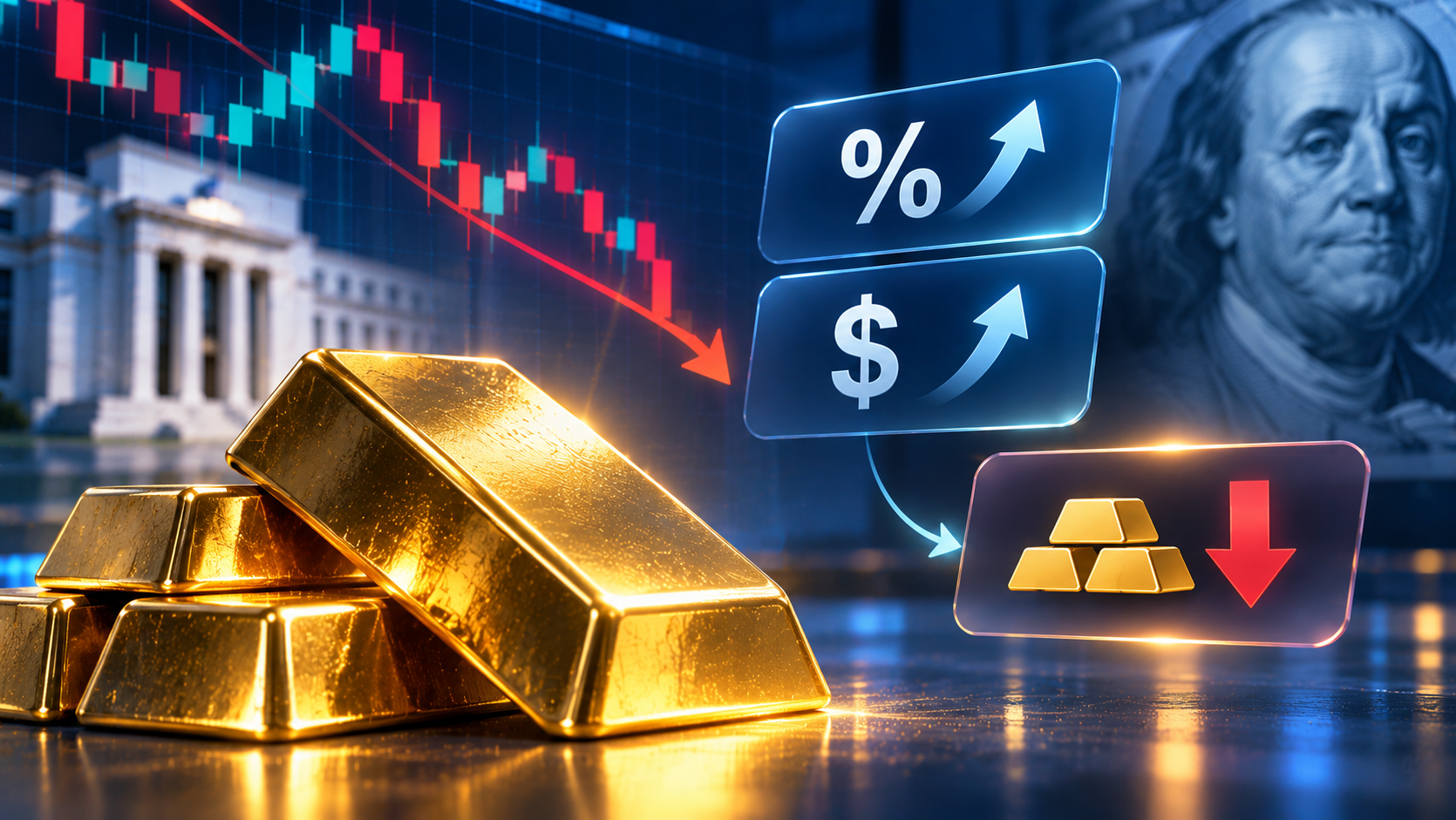
The mechanics are straightforward. A Fed December rate hike raises real yields, the return investors earn on US government bonds after adjusting for inflation. When real yields are positive and rising, the opportunity cost of holding gold, a non-yielding asset, increases. Money moves from bullion into Treasuries. The dollar strengthens simultaneously, applying a second layer of downward pressure on gold, which is priced in dollars.
According to Reuters, gold rose 2.75% last Monday as dip-buyers moved in after the sharp weekly decline. But the metal gave back gains quickly as dollar strength resumed. The bounce was a tactical correction, not a trend reversal. The 10-year Treasury yield near 4.92% remains the primary headwind for gold. Until that yield pulls back materially, gold is trading in a range defined by dip-buying on the downside and Fed rate hike pressure on the upside.
A softer PCE print today would be the most bullish near-term scenario for gold. If October core PCE comes in below the 0.3% monthly consensus, traders would interpret it as evidence that inflation is cooling, reducing the case for hikes beyond December. That repricing of the 2027 path would pull yields lower, weaken the dollar, and give gold room to test resistance toward $3,700.
Britannia Bullion's Matthew Jones, as cited by FX Leaders, expects gold to consolidate into 2027 rather than mount a sustained recovery while real rates remain positive. That view aligns with the current setup: range-bound gold with event-driven volatility around data prints, rather than a directional trend in either direction until the Fed's tightening cycle clearly ends.
What Traders Need to Watch Today
The October PCE and Q3 GDP second estimate release at 13:30 GMT, which is 8:30pm Malaysia time. The release window is thin liquidity for Asian traders, but the reaction in USD, gold, and US equity futures will be visible immediately and will set the tone for Thursday's Asian open.
The key levels to monitor:
- US Dollar Index: Support near 103.00, resistance at the 103.66 high. A hot PCE pushes toward 104.00. A soft PCE sees a pullback toward 102.50.
- Gold (XAU/USD): Support at $3,500, near-term resistance at $3,650–$3,700. A hot PCE retest lows. A soft PCE opens the path toward $3,700.
- EUR/USD: Trading near 19-month lows at $1.0985. Hot PCE could push toward $1.0900. Soft PCE likely sees a relief bounce toward $1.1050.
- AUD/USD: Holding below 0.6850. Risk-off and dollar strength cap any recovery. Watch for follow-through selling on a hot print.
Beyond the data, the Fed's Beige Book releases today as well. The Beige Book is a qualitative survey of economic conditions across the Fed's 12 districts. Any language in the Beige Book describing persistent price pressures or strong labor demand would reinforce the Fed December rate hike narrative and add further support to the dollar.
The Bigger Picture: One Hike or a Cycle?
The Fed December rate hike debate has shifted. It is no longer about whether December happens. It is about whether December is the last move or the second-to-last. That distinction matters enormously for asset prices. A Fed that hikes in December and pauses is a very different market environment from a Fed that hikes in December and signals two more moves in 2027.
The data today will not definitively answer that question. But it will move the needle. A hot PCE print pushes the 2027 rate path higher, keeps the dollar bid, and maintains pressure on gold and risk assets. A soft PCE opens the door to a December hike with a dovish tilt in the statement, which would be the most market-friendly outcome: the hike happens, the cycle appears to pause, and the dollar gives back some of its recent gains.
According to Oxford Economics, markets are overpricing the odds of a 50-basis-point December move. That excess pricing creates a vulnerability: if the data confirms 25 basis points is the right call and the statement is neutral, the dollar could actually pull back slightly even as the hike is delivered, in a classic "buy the rumor, sell the fact" response.
For traders, the message is to watch the data, watch the Beige Book, and wait for the December 9 meeting statement. The Fed December rate hike itself is settled. What is not settled is what comes after it, and that uncertainty is what will drive USD, gold, and forex markets through the end of the year.
According to Reuters and Investing.com, November 25, 2026. This article is for informational purposes only and does not constitute financial advice. Trading involves risk. Please consider your financial situation before making any trading decisions.
FAQ
Frequently asked questions
Will the Fed raise rates in December 2026? +
Markets are pricing a 91% probability of a Fed December rate hike, according to the CME FedWatch tool. Fed Governor Christopher Waller stated he would support a quarter-point hike regardless of the PCE reading, while Dallas Fed President Lorie Logan indicated more aggressive tightening may be necessary.
What is the PCE inflation reading and why does it matter? +
The PCE price index is the Federal Reserve's preferred inflation gauge. The September 2026 reading showed PCE rising 3.6% year-over-year, well above the Fed's 2% target. The October 2026 PCE report releases today, November 25, and will directly influence expectations for the Fed December rate hike.
How does the Fed December rate hike affect gold prices? +
A Fed December rate hike strengthens the US dollar and raises real yields, both of which are negative for gold. Gold fell nearly 3% in a single session in November after hot inflation data reinforced rate hike bets, and the metal hit a 14-month low before rebounding. A softer-than-expected PCE reading could provide relief.
What does the Q3 2026 GDP revision mean for the Fed? +
The Q3 2026 GDP advance estimate showed 3.4% annualized growth, beating the 3.2% consensus. The second estimate releases today alongside October PCE. Strong GDP supports the Fed's case for further tightening, as robust growth reduces the risk that a December hike tips the economy into recession.
How high is the US dollar index and what is driving it? +
The US Dollar Index rose to 103.66, its highest level in 19 months, as markets priced the Fed December rate hike as near-certain. Hot inflation data, hawkish Fed commentary, and strong Q3 GDP all supported USD strength. The euro fell to a 19-month low, and the Australian dollar hit a 10-month low against the greenback.
Trade the markets you follow
Open a live or demo account in minutes
KVB Market Analysis
Latest from our insights