

US Midterm Elections Rattle AI Stocks
US Midterm Elections Rattle AI Stocks
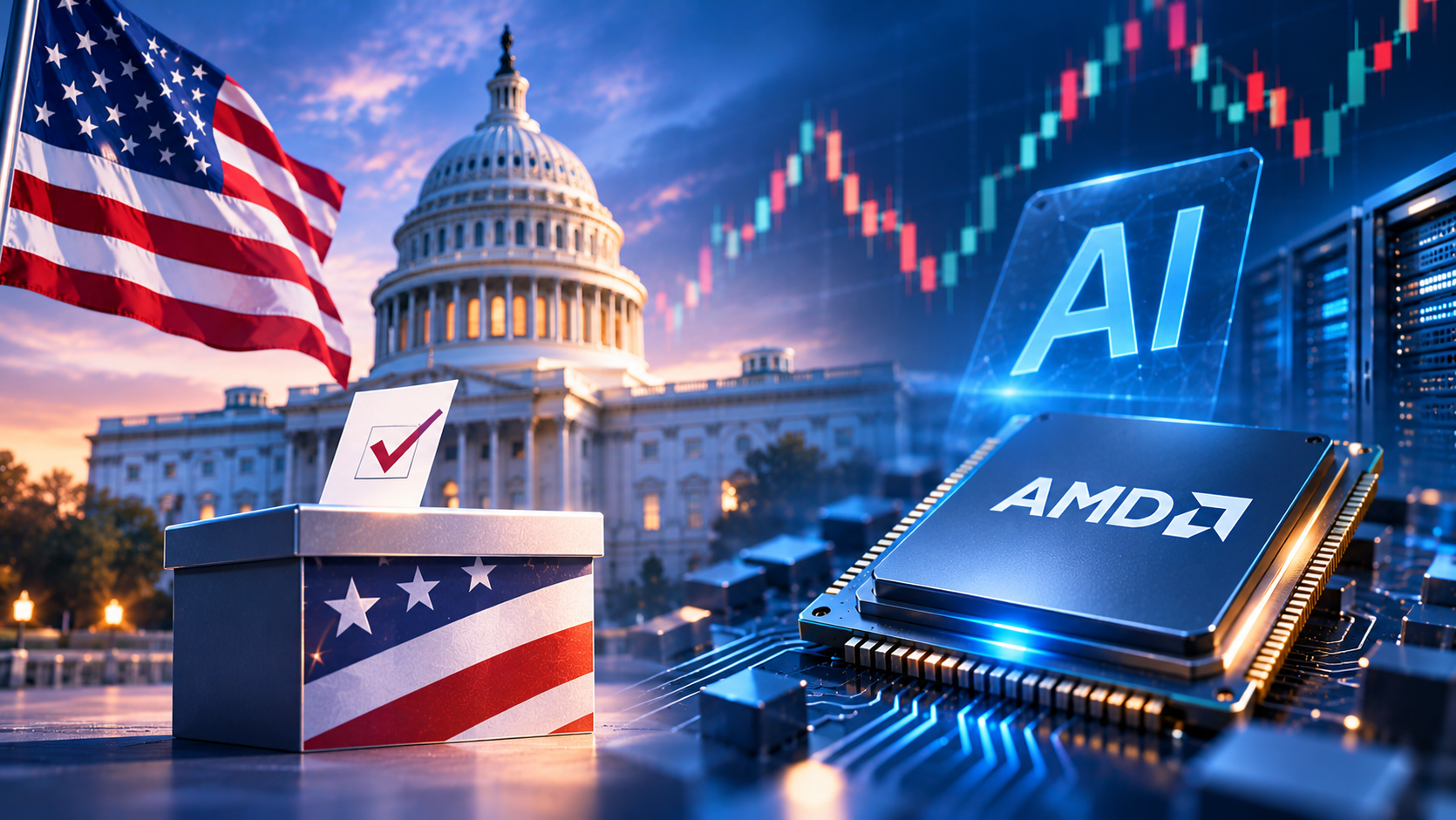
Wednesday opened on edge. US stock futures slid as results from the November 3 midterm elections began rolling in, with S&P 500 futures down 0.5% and Nasdaq futures off 0.9%. Democrats were favoured to capture the House, while the Senate remained a state-by-state battle too close to call. For traders watching midterm elections AI stocks, the central question was not simply who wins Congress. The question was whether a decisive Democratic majority would translate into the kind of regulatory crackdown that could reshape the investment case for technology and artificial intelligence.
At the same time, one piece of news cut against the anxiety. Advanced Micro Devices reported record third-quarter results after the bell on Tuesday, posting revenue of $13.4 billion, up 45% year-over-year, with Data Center segment revenue nearly doubling. The result, described by Reuters as offering a strong counterpoint to mounting fears that the AI boom is losing steam, gave Asian markets a degree of stability even as election uncertainty kept a lid on broader gains.
The two stories are running in parallel right now. One is about the durability of AI demand. The other is about whether Washington is about to change the rules of the game. For anyone trading technology-linked instruments, both matter.
What the Midterms Mean for AI Stocks
The 2026 midterm elections arrived at an already difficult moment for midterm elections AI stocks. The Nasdaq Composite wrapped up October with its worst month since March 2025. A string of disappointing results from Alphabet, Amazon and Intel triggered sharp declines in AI-linked names, and strategist Marta Norton of Empower told Reuters that the market "seems a bit troubled," with AI fears that are "persistent, if not building."
Against that backdrop, the political stakes sharpened. Many Democratic candidates ran on platforms that included greater scrutiny of AI infrastructure, with particular focus on the energy demands of large data centers. The concern for investors is straightforward: if Democrats win control of Congress with enough margin to push through legislation, the costs and timelines for the AI buildout could lengthen significantly.
Chris Weston, head of research at Pepperstone, framed the trader's calculus precisely. According to Reuters, Weston said the greatest market reaction may come not from who wins Congress, but from how decisively they win and how far the result deviates from expectations. "A narrow blue wave may be largely priced in," he said. That means a narrow Democratic majority, while unsettling, may already be reflected in current valuations. A commanding sweep is the scenario that carries real downside surprise.
The policy concerns investors are pricing in are specific. A Democratic-controlled House could advance bills restricting data center siting, requiring greater transparency in AI model training, and imposing new compliance requirements on AI-deployed financial and healthcare systems. None of these are confirmed outcomes. They are, as Reuters has consistently framed them, investor concerns. But in a market where sentiment has been driving price action more than fundamentals, concerns carry weight.
AMD Delivers a Record Quarter
While the political noise swirled, AMD gave the market something concrete to hold onto. The company reported Q3 2026 revenue of $13.4 billion, exceeding the high end of its own guidance. Non-GAAP earnings per share came in at $2.09, with a non-GAAP gross margin of 56%. Data Center segment revenue nearly doubled year-over-year, driven by strong demand for the company's Instinct AI accelerators and EPYC server processors.
Lisa Su, AMD's chief executive, credited "broad-based demand" and "record revenue and profitability" as the company continued to scale its AI infrastructure business. For the fourth quarter, management guided for "accelerating revenue and earnings growth, driven by strong demand across our Data Center portfolio."
The timing was important. AMD reported just one week after Intel cratered nearly 29% on weak guidance, and against a backdrop where Alphabet and Amazon's heavy AI spending had spooked investors. The contrast was stark. Where Intel signalled pressure on margins and demand, AMD signalled the opposite. Where the hyperscalers raised questions about whether AI investment was generating returns, AMD's data center numbers suggested that chip demand from those same hyperscalers remained intact.
For traders watching midterm elections AI stocks, the AMD result introduced a split narrative. The political environment is adding a risk premium to the whole sector. But at the component level, at least one of the most watched AI chip suppliers is showing no sign of a slowdown. That tension between macro political risk and company-level execution is what the market is now trying to price.
Asian Markets: Cautious but Supported
Asian equity markets opened Wednesday in a holding pattern. Tech stocks found buyers after AMD's results, but the broader mood remained cautious as election results filtered through overnight. According to Reuters, Asian markets inched higher as beaten-down tech stocks found favour, with AMD's results easing some concerns over the durability of the AI trade.
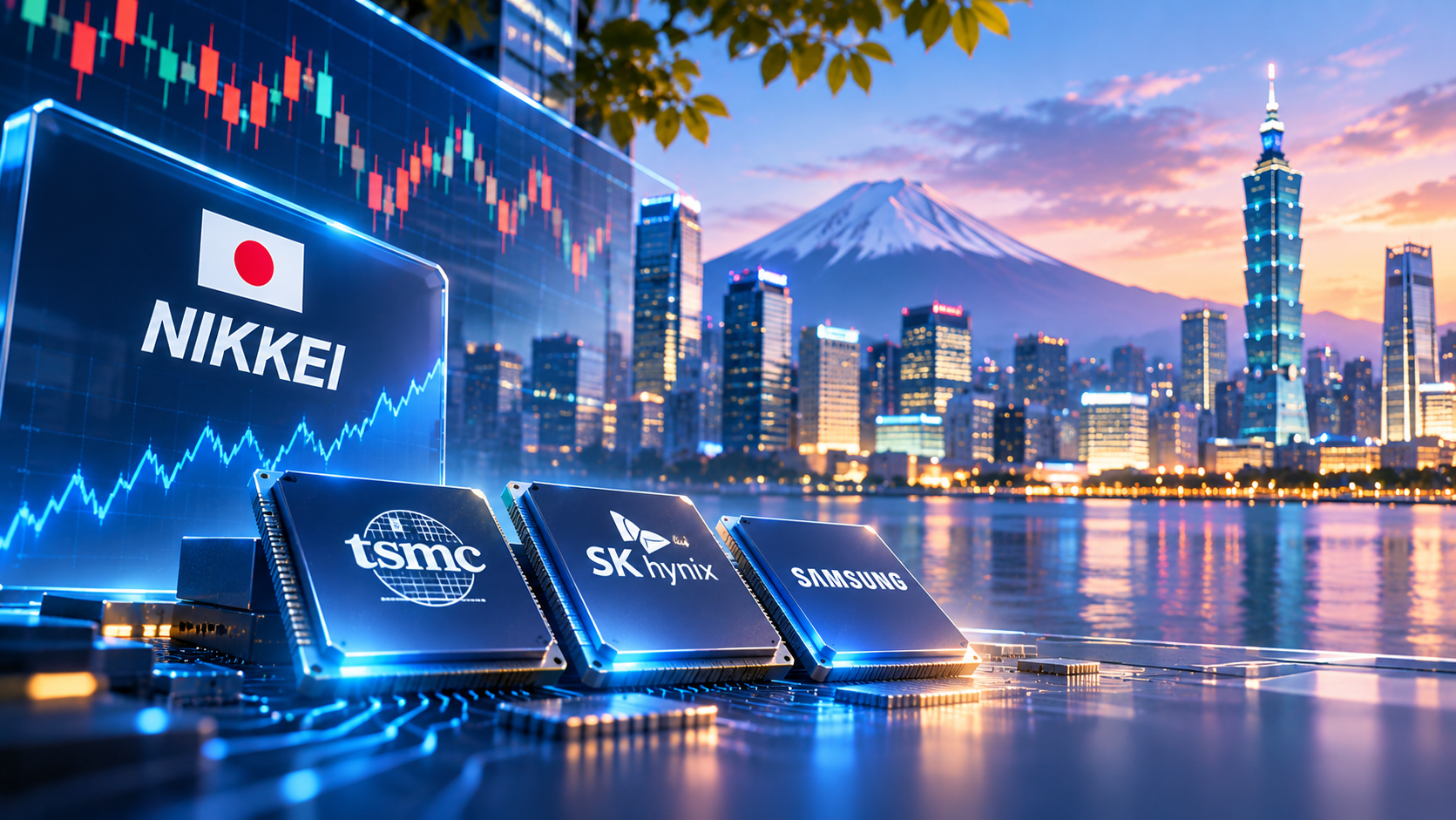
The regional picture was uneven. South Korean and Taiwanese markets, both heavily exposed to semiconductor supply chains, were better supported. Japan's Nikkei edged lower as traders returned from a public holiday and weighed the combination of US election uncertainty and yen movement. Australia's ASX futures pointed down.
Underlying the moves is a consistent pattern that has defined midterm elections AI stocks trading throughout 2026: Asia's technology benchmarks have outperformed their US counterparts for much of the year, driven by strong semiconductor export data and the region's central role in AI chip manufacturing. TSMC, SK Hynix and Samsung have all benefited from the same infrastructure buildout that is now under political scrutiny in Washington. A regulatory slowdown in the US would not eliminate that demand immediately, but it would change the growth trajectory that investors have been willing to pay up for.
"The market is much more broad than people generally want to give it credit for."
Chief Investment Strategist, Empower, as reported by Reuters
That breadth matters for Asian traders. While AI and technology have dominated headlines, other sectors have quietly picked up slack during the recent tech selloff. Healthcare, energy and financial stocks across the region have held firmer ground. The midterm results will not change that dynamic overnight, but they add a layer of complexity for anyone positioned heavily in AI-linked names.
The Regulatory Risk Traders Are Pricing
To understand the specific fear driving midterm elections AI stocks lower in recent weeks, it helps to look at what a Democratic majority on key Congressional committees could actually do. The focus is on three areas.
- Data center oversight: Multiple Democratic candidates have campaigned against unrestricted data center expansion, citing power grid pressure, water usage and local community impact. Legislation restricting siting or requiring environmental review could increase costs and delay new capacity.
- AI model transparency: Proposals to require documentation of training data, model capabilities and risk assessments have circulated in Congressional draft bills. Compliance costs for large AI developers would rise.
- Financial and healthcare AI scrutiny: Regulators including the SEC and CFPB have shown interest in how AI is being deployed in trading, credit and insurance decisions. A new Congress sympathetic to consumer groups could accelerate enforcement.
None of these are certainties. As Wells Fargo analysis cited by Bloomberg notes, the S&P 500 has risen in the 12 months following every midterm election in the post-World War II era, regardless of which party gained seats. Markets have historically been more responsive to economic fundamentals and Federal Reserve policy than to election outcomes. The question is whether 2026 is different, given how much of the market's value rests on a single theme.
The Federal Reserve adds another layer. Markets are currently pricing approximately an 80% probability of a December rate hike, according to Reuters. Higher rates have historically pressured richly valued growth stocks by raising the discount rate applied to future earnings. For AI companies spending massively on infrastructure today in anticipation of profits years from now, that pressure is direct. The election outcome could amplify or dampen it, but the rate dynamic is already in the price.
What Traders Are Watching This Week
Beyond the election results, three additional catalysts are live this week for anyone tracking midterm elections AI stocks.
Qualcomm reports earnings this week, offering another read on chip demand after AMD's strong numbers and Intel's weak guidance. The divergence between AMD and Intel has become the central debate in semiconductors: is the AI chip market broad and durable, or is it concentrated in a narrow set of products that only specific suppliers can serve? Qualcomm's results, particularly its commentary on mobile AI and data center adjacencies, will help answer that.
The October jobs report arrives Friday, November 6. September showed the US economy adding just 29,000 jobs, well below expectations. A second consecutive soft reading could ease some pressure on the Fed's December decision, potentially pulling rate hike odds back below 80%. For tech stocks that have been weighed down by rate expectations, any softening in the December hike probability is a direct positive catalyst.
And the election results themselves will continue to shape sentiment through the week. Early calls do not capture the full picture. The Senate outcome in particular could remain uncertain for days, and the market will likely trade with elevated volatility until the Congressional balance of power is clear.
The Bigger Picture for AI Investment
It is tempting to read the current midterm elections AI stocks pressure as a turning point for the AI trade. The Nasdaq's worst month since March 2025, disappointing results from two of the largest AI spenders, an election that could bring regulatory headwinds, and a central bank moving toward tighter policy: the list of negatives is not short.
But AMD's results sit on the other side of that ledger. Data center revenue nearly doubling year-over-year is not a sign of a trade running out of room. It is a sign that the underlying demand for AI compute infrastructure remains strong, even as the market debates whether the returns justify the investment. Lisa Su's confidence in Q4 guidance, and the company's new AI chip partnerships with Oracle and OpenAI, point to a pipeline that extends well beyond any single earnings cycle.
The more useful framing for traders is not whether AI is in trouble, but where within the AI supply chain the value is concentrated. Chip suppliers with direct exposure to data center build-outs, like AMD and TSMC, have reported numbers that hold up. Hyperscalers spending at scale, like Alphabet and Amazon, have raised questions about whether the investment is generating the returns needed to sustain current valuations. That divergence is likely to persist regardless of how the midterms resolve.
Defense and healthcare stocks are the other side of the political trade. Analysts note that a Democratic majority could shift fiscal priorities away from defense, while potentially boosting healthcare spending. Traders positioned in broad US equity exposure through indices like the S&P 500 or Nasdaq should be aware that sector rotation, not just an AI-specific move, is part of the election reaction.
Key Levels and Instruments to Watch
For those trading US equity indices, the S&P 500 is currently at 7,558, down 0.14% on Wednesday and trading below resistance at the lower limit of the previous multi-month range between 7,620 and 7,800. This is the first time the benchmark has traded below its 100-day moving average since March 2026. The 20 and 50-day moving averages are no longer serving as support. These are technically relevant levels for CFD traders managing short-term exposure.
The Nasdaq Composite and the Philadelphia Semiconductor Index, which tracks the chip sector, will be the most direct read on how midterm elections AI stocks continue to price. Any decisive election outcome that removes uncertainty, in either direction, is likely to trigger a sharp directional move in both.
On currencies, the US dollar softened overnight as markets processed the early results. USD/JPY and USD/KRW are worth monitoring given Japan and South Korea's heavy exposure to the semiconductor trade. A stronger yen or won on risk-off sentiment would reflect further pressure on AI-related positioning. Gold, which has held firm through recent market volatility, remains a watch for traders seeking a hedge against extended equity weakness.
Outlook
The 2026 midterm elections have landed at the intersection of two major market debates: the sustainability of the AI investment cycle and the direction of Federal Reserve policy. AMD's record quarter on Tuesday night showed that demand for AI chips remains intact at the component level. The election results will determine whether Washington decides to slow the infrastructure buildout that is feeding that demand.
As Reuters reports, the greatest risk is not necessarily a narrow Democratic win, which markets may have already priced. The risk is a commanding sweep that shifts the regulatory outlook more sharply than expected. That outcome, combined with a December Federal Reserve rate hike, would put AI-linked valuations under real pressure heading into year-end.
History says markets tend to find their footing after midterms, whatever the result. But as strategists have noted heading into this election, 2026 is not a typical midterm year. The AI trade is too central to the market's gains, the rate environment too challenging, and the political stakes around technology too high for a simple return to business as usual. Traders watching midterm elections AI stocks should expect volatility to remain elevated through the rest of the week, with the jobs report on Friday providing the next major data point for how the Fed and the market recalibrate from here.
FAQ
Frequently asked questions
How do US midterm elections affect AI stocks? +
US midterm elections introduce regulatory uncertainty for the technology sector. A Democratic-controlled Congress could push for stricter AI oversight, limits on data center expansion, and greater scrutiny of large technology firms, all of which weigh on AI stock valuations in the short term.
What did AMD report in Q3 2026? +
AMD reported record Q3 2026 revenue of $13.4 billion, up 45% year-over-year. Data Center segment revenue nearly doubled. Non-GAAP EPS came in at $2.09. The company issued strong Q4 guidance, citing accelerating demand across its Data Center portfolio.
Could a Democratic victory lead to tougher AI regulation? +
Investors see a Democratic sweep as the scenario most likely to bring tougher AI oversight. Policy concerns include restrictions on data center expansion, greater scrutiny of AI infrastructure spending, and new rules for large technology companies. These remain investor concerns rather than confirmed outcomes.
How have Asian markets reacted to the US midterm results? +
Asian markets moved cautiously on November 4, 2026, with tech stocks finding support after AMD's strong Q3 results helped ease fears about the durability of the AI trade. US stock futures fell, with S&P 500 futures down 0.5% and Nasdaq futures off 0.9%, reflecting ongoing election uncertainty.
Do stock markets usually rise after midterm elections? +
Historically, US stocks have posted positive returns in the 12 months following every midterm election in the post-World War II era, according to Wells Fargo analysis. However, the S&P 500 has already recorded double-digit gains in 2026, which some analysts say limits the typical post-midterm bounce.
Trade the markets you follow
Open a live or demo account in minutes
KVB Market Analysis
Latest from our insights