



Asian Market Selloff: What AI Traders Got Wrong
Asian Market Selloff: What AI Traders Got Wrong
Thursday started the way nobody in Asia wanted it to. The Asian market selloff that played out on October 15 was not a total surprise after what Wall Street had already done the night before, but the speed and the scale of the declines still hit harder than most expected. A hotter-than-expected US consumer price inflation reading was the trigger, but what followed was bigger than a simple macro reaction. It was a reality check for the AI trade, and it was not pretty.
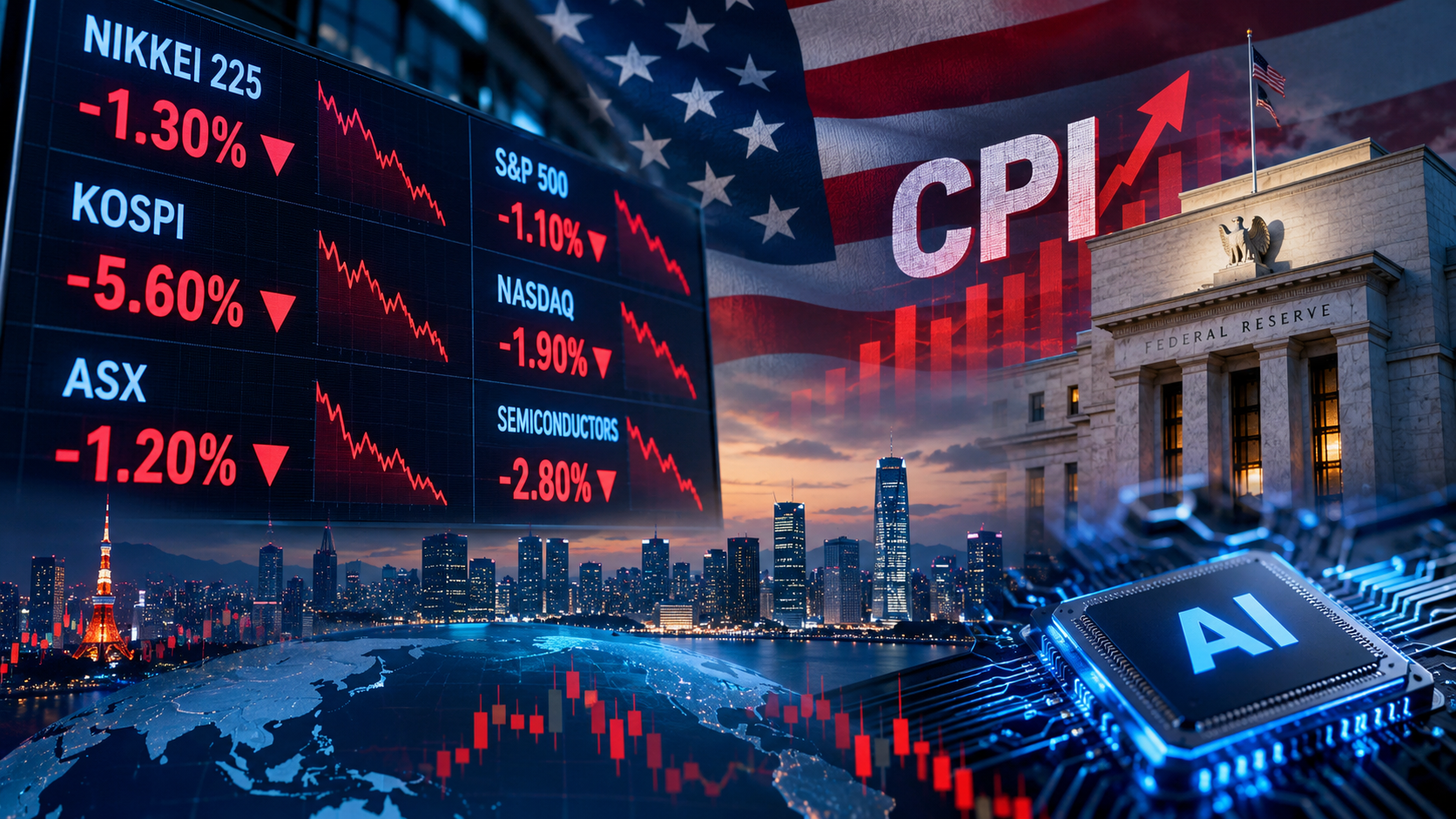
According to Reuters, MSCI's broadest index of Asia-Pacific shares outside Japan dropped 1.2%, while South Korea's KOSPI plunged 5.6%. The Nikkei 225 fell 1.3%. S&P 500 e-mini futures were down 0.3% as the session opened. For traders watching those numbers roll in, the obvious question was whether this was a dip to buy or the start of something more serious.
There is no clean answer to that. But the context matters here, and the context right now points toward caution. This is not just a one-day volatility story. There are structural cracks in the AI trade that higher interest rates are beginning to expose, and Thursday gave the market another look at exactly how wide those cracks are.
The CPI Trigger That Started It All
The September US consumer price index came in above expectations, and that was enough to shake loose a market that had already been sitting on fragile ground. Investors had mostly been pricing in a pause from the Federal Reserve on rate hikes. That assumption is now under serious pressure.
According to Reuters, fed funds futures shifted to price in a 31.6% probability of a 25-basis-point hike at the Fed's October 28 meeting, up from 22.1% the day before. That kind of move in a single session matters. When the probability of a rate hike jumps by nearly 10 percentage points overnight, it forces a reassessment across equities, bonds, and currency markets simultaneously.
The Asian market selloff on October 15 was a direct consequence of that repricing. Higher rate expectations mean a higher discount rate applied to future earnings, which hits growth stocks first and hardest. Technology and AI names, where valuations are built on earnings projections years out, take the worst of it. That is exactly what happened on Thursday.
The Federal Reserve has had a genuinely difficult job throughout this cycle. Inflation has stayed stickier than its models suggested, and the central bank has been walking a line between tightening too much and doing too little. September's CPI data was a signal that the "too little" risk is still very much alive, and markets responded accordingly.
AI Stocks Take the Hardest Hit
The selloff in technology was not random. JPMorgan analysts, cited in the Reuters report, pointed directly at AI as the central problem, with financing risks and IPO timelines driving the decline more than the macro trigger itself. That is a critical distinction. This is not just interest rates making tech stocks less appealing on a relative basis. There is a specific concern about how AI infrastructure companies are structured financially, and whether those structures hold up when borrowing costs stay elevated.
Oracle and CoreWeave, both named in the Reuters report as among the hardest hit, carry heavy exposure to the cost of capital. CoreWeave in particular is built around borrowing to acquire NVIDIA GPUs and leasing that computing power to AI companies. When rates rise, the debt gets more expensive. When the timeline for AI revenue starts to slip, investors start asking whether the whole model still makes sense.
The Asian market selloff was partly a product of those concerns spreading outward from Wall Street. Asian chipmakers and technology names that had been riding AI-related demand found themselves dragged down alongside their US counterparts. South Korea's KOSPI, with its heavy concentration in semiconductors and electronics, fell the hardest in the region at 5.6%. That is not a rounding error. That is a market telling you something.
Chris Weston, head of research at Pepperstone Group Ltd in Melbourne, flagged the specific risk in a note cited by Reuters: "KOSPI and Nikkei futures point to renewed technology weakness, with leveraged ETF flows and AI infrastructure credit risk firmly in focus." The leveraged ETF point is worth sitting with. When those funds start unwinding under pressure, they amplify market moves in ways that go well beyond what fundamentals alone would produce. That dynamic looks like it was a factor on Thursday.

All Eyes on the Federal Reserve
Every piece of data between now and the October 28 Federal Open Market Committee meeting is going to be read through one filter: what does it mean for rate policy? Thursday already had a full slate of Fed-related events on the calendar. US producer prices and retail sales were due later in the day, and Federal Reserve Chair Kevin Warsh was scheduled to speak at events in Bangkok alongside other officials.
Markets listen closely to the Fed chair in moments like these. If Warsh leans into the inflation data and signals that further tightening is on the table, the Asian market selloff story will have more room to run. If officials push back and signal patience, there may be some relief. But the CPI print has shifted the starting point of that conversation, and it will take meaningful pushback to move expectations back in the other direction.
According to Reuters, the yield on the US 10-year Treasury fell 4.4 basis points to 5.144% on Thursday. That might seem strange if rate hike expectations are going up, but it likely reflects a safety trade as equities sold off sharply, with investors moving into government bonds as equities took the brunt of the hit.
A 10-year yield sitting above 5% is a structurally different backdrop from what markets have grown used to over the past decade. At that level, the risk-free rate is competitive enough to make the earnings yields on many growth stocks look thin. That is one of the core reasons the AI trade has become so sensitive to any macro development that shifts rate expectations. The low-rate cushion that made speculative AI positioning feel safe is gone.
What the Currency Markets Were Saying
The currency moves on Thursday added texture to the broader picture. According to Reuters, the US dollar slipped 0.2% against the Japanese yen to 157.925, the euro gained 0.3% to $1.1194, and the Australian dollar fell 0.2% to $0.6956.
The Aussie dollar had its own specific problem: September employment data showed an unexpected drop of 39,300 jobs against forecasts of a 20,000 gain. That is a miss that goes in the wrong direction by nearly 60,000 jobs. For commodity-linked currencies, global risk sentiment and domestic fundamentals rarely work independently of each other, and on Thursday both were pointing down.
The yen's slight appreciation against the dollar is relevant to the Asian market selloff context. The Bank of Japan has been cautiously moving away from its ultra-loose stance, and any further steps in that direction could add to yen strength. A stronger yen, in turn, creates revenue headwinds for Japanese exporters, which helps explain why the Nikkei 225 was lower despite the yen move being relatively modest.
For forex traders, Thursday was another reminder that currencies do not trade in isolation. US rate expectations, equity market conditions, and individual central bank policies all feed into each other. When one piece of the puzzle shifts suddenly, the correlations that traders had built their positioning around can break down fast. A single CPI print does not just move equities. It moves everything.

TSMC Earnings Could Shift the Mood
While Asian markets were working through the fallout from Wall Street's third straight day of losses, attention was already building toward a major event: TSMC's third-quarter earnings, due later in the Asian trading session on Thursday.
TSMC is the most important single company for assessing whether AI demand in the real economy is holding up. If the numbers disappoint, or if guidance for the coming quarters is cautious, it adds weight to the concerns about AI monetization timelines that have been circulating all week. A strong result could offer some counterbalance to the anxiety that has been fuelling the Asian market selloff.
The context made these results unusually significant. According to Reuters, semiconductor stocks had already fallen for six consecutive sessions going into Thursday. Investors were watching the TSMC report closely for any signal that end demand from AI customers remains strong, since that is the foundational assumption holding the sector's valuation story together.
- TSMC is the world's largest contract chipmaker and the primary manufacturer of advanced processors used in AI applications globally.
- Its quarterly guidance is treated as one of the most reliable leading indicators for semiconductor sector demand.
- Any sign of slowing demand or cautious outlook would likely extend the sector's losing streak.
- A strong beat would not fix the macro picture, but it could provide evidence that AI chip demand is still growing despite the financial turbulence around infrastructure players.
The timing made it a high-stakes read either way. TSMC's results were landing in the middle of a session already defined by nervousness, which meant investors were primed to react strongly in whichever direction the numbers pointed.
What This Session Tells Us About the AI Trade
The Asian market selloff on October 15 was not just a bad day in markets. It was a diagnostic. It showed which parts of the current investment landscape are genuinely exposed to the kind of macro shock that a surprise CPI print delivers, and AI infrastructure came out as the most vulnerable category by a considerable margin.
Part of what makes this difficult is that the underlying technology is real. Nobody serious is arguing that AI will not reshape significant parts of the global economy. The argument is narrower and more financial: given what it costs to build AI infrastructure, and given the current cost of capital, are the companies doing that building worth what the market had been pricing them at? Thursday's answer was a firm no, at least for now.
JPMorgan analysts, as reported by Reuters, identified AI as "the main challenge" in the day's declines, with financing risks and IPO timelines at the centre of investor concern rather than the CPI trigger alone.
That distinction matters. The CPI data was the spark, but the fuel was already there. The AI trade had been running on a set of assumptions that higher rates put under strain: that AI companies would monetize quickly enough to justify their debt loads, that IPO windows would remain open, that infrastructure capex would eventually produce returns that made the initial investment look sensible. Each of those assumptions is now being questioned more openly, and the Asian market selloff is part of that questioning process playing out in real time.
What Traders Need to Watch From Here
For anyone with exposure to Asian equities, AI-related stocks, or regional currency pairs, Thursday's session clarified a few things that had been building for weeks.
- The AI trade does not exist outside the macro environment. The narrative had become powerful enough that many investors treated AI as a category that would outperform regardless of interest rates or broader growth conditions. Thursday pushed back on that idea again. When CPI surprises to the upside and rate hike probabilities move sharply, AI stocks get hit. That is not a one-off pattern.
- Concentration amplifies everything. The heaviest losses landed in a small number of names. When sentiment turns in a concentrated trade, the moves can be severe. Leveraged ETF flows, as Pepperstone's Chris Weston noted in the Reuters report, make those swings worse. Position sizing and risk management are not optional in this environment.
- The bond market is part of the story. A 10-year Treasury yield above 5% changes the math for risk assets in a fundamental way. This is not just about whether AI companies will eventually be profitable. It is about whether the business models make sense right now, at current financing costs, with current revenue timelines.
According to Reuters, investor focus heading into the rest of the week is on Fed officials including Chair Kevin Warsh, as well as producer prices and retail sales data. Each of those will help clarify whether September's CPI was a one-off blip or the opening of a more sustained inflation resurgence. The answer shapes everything that follows.
The phase of the AI trade where enthusiasm could override macro headwinds and poor risk discipline still paid off is probably behind us. What comes next requires more rigorous analysis of actual cash flows, debt structures, and rate sensitivity. The Asian market selloff triggered by October's CPI data is one chapter in a reassessment that is likely to run for some time. Traders who approach it with clear-eyed analysis and managed risk will be better placed than those still betting on the old narrative holding together.
Markets reprice. Thursday reminded everyone of that. The question now is how far the repricing has to go before the fundamentals and the valuations find each other again.
According to Reuters, investor attention in the days ahead will centre on Federal Reserve officials, producer price data, and retail sales figures, each of which will help determine whether October's CPI print was an isolated shock or the start of a longer inflation story. Whether the AI trade finds its footing again depends heavily on that answer. But one thing Thursday made clear: the era of betting on AI without watching the macro is over.