



Oil Spikes as US Enforces Hormuz Blockade, 20% Fee
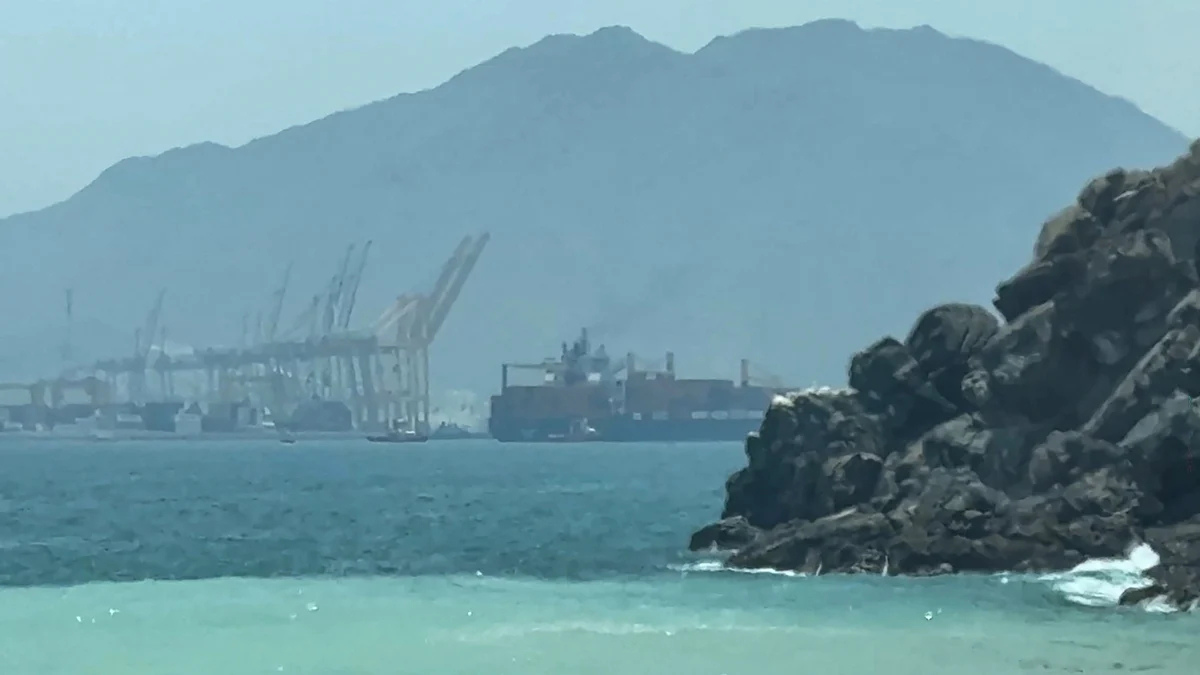
Global energy markets jolted higher this week after the United States moved to reinstate a naval blockade around the Strait of Hormuz and announced plans to charge a 20% fee on cargo transiting the waterway, reigniting fears of a prolonged supply shock just as Wall Street braces for a heavy slate of second-quarter earnings.
Blockade Enforcement Begins Tuesday Afternoon
US Central Command said the blockade would take effect at 4 p.m. ET on Tuesday, targeting vessels transiting to or from Iranian ports and coastal areas. The announcement followed a weekend in which the US and Iran traded strikes, including attacks on energy infrastructure that all but erased hopes of a durable de-escalation. The Strait of Hormuz is the corridor through which roughly a fifth of the world's oil and gas traffic has historically passed, and any prolonged disruption there carries outsized consequences for global fuel prices.
President Trump framed the action as a protective measure rather than an act of aggression against commercial shipping generally. "The Strait of Hormuz is OPEN, and will remain OPEN, with or without Iran," he wrote on Truth Social, adding that the US would act as the waterway's guardian and would be "reimbursed" for the service.
Key Numbers
Brent crude: jumped as much as 9.6% Monday, its biggest one-day gain since May 2020, trading above $85
WTI crude: rose above $80 a barrel, a level not seen in nearly a month
Proposed transit fee: 20% on all cargo shipped through the strait
Estimated daily fee revenue: roughly $250 million a day, according to trade estimates
A 20% Toll With No Clear Legal Basis
The proposed 20% fee would apply to all cargo shipped through the strait, not only Iran-linked traffic, and Trump said the US would collect it as compensation for providing security in what he called "this very volatile section of the World." Precisely how Washington intends to collect such a levy remains unclear, and legal scholars note that the US is not a party to the UN Convention on the Law of the Sea, the treaty framework that governs transit rights through international straits.
The International Maritime Organization pushed back within hours of the announcement. "We have always been consistent on our stance on fees," IMO Secretary-General Arsenio Dominguez said in a statement, adding that the agency opposes any charge for passage through straits used for international navigation and that there is no legal basis for mandatory tolls. The US Treasury Department has separately warned that companies paying Iran for transit rights could run afoul of sanctions law, calling such arrangements "maritime extortion" — a designation that now sits awkwardly beside Washington's own proposed 20% fee.
Freedom of navigation through international waterways is a very well-established principle. Anything like this would begin to say that countries adjacent to an international waterway can charge some sort of a transit fee.
Energy executives have previously rejected similar proposals when raised by Iran, and shipping industry groups are watching closely to see whether the 20% fee is enforced in practice or remains largely rhetorical.
Traffic Through the Strait Already Thinning
Even before Monday's announcement, ship-tracking data showed a marked pullback in traffic. According to intelligence firm Kpler, transits through the Strait of Hormuz fell 52% week-on-week over the July 10–12 period, with vessels increasingly attempting so-called "dark" crossings — switching off location beacons to avoid detection. That defensive posture reflects growing wariness among shipowners and insurers after a chaotic weekend in which Iran struck two UAE-flagged supertankers in the strait, killing one crew member and injuring eight others.
- US Central Command says it redirected more than 140 "compliant" vessels and disabled nine "non-compliant" ones during an earlier phase of the blockade between April and June
- Iran's Revolutionary Guard Corps says it intercepted two vessels using what it called an "illegal" route through the strait
- Kuwait reported damage to an offshore drilling platform, the first direct strike on energy infrastructure in weeks
- GasBuddy analyst Patrick De Haan expects US retail gasoline to approach $4 a gallon within seven to ten days
Markets React: Energy Up, Growth Stocks Under Pressure
US equities slid into the close on Monday as the blockade news broke, with the S&P 500 down 0.79% to 7,515.34 and the Nasdaq Composite off 1.55% to 25,873.18, weighed down by a renewed bout of profit-taking in AI-related chip names. The Dow Jones Industrial Average fell a more modest 0.26%. Energy shares were the notable exception, with the sector-tracking XLE ETF advancing as crude prices climbed, led higher by exploration and production names.
Asian markets were mixed heading into Tuesday. Japan's Nikkei 225 and South Korea's Kospi each advanced roughly 0.7%, while the Shanghai Composite added about 1.1% on the back of strong Chinese AI-related export data. India's benchmark indices, the Sensex and Nifty 50, were expected to open lower, tracking weak global cues even as analysts pointed to resilient domestic fundamentals heading into the Q1 FY27 earnings season.
Analyst Take
"The latest developments have shifted market focus from oversupply concerns to the risk of prolonged disruptions to Gulf energy exports, with the duration of US enforcement measures and the security of Hormuz now likely to determine whether oil prices remain elevated," said Soojin Kim, research analyst at MUFG.
How Far Could This Go?
Analysts are split on the durability of the latest spike. Norbert Rucker, head of economics and next-generation research at Julius Baer, argued that oil and gas should largely continue to flow through the strait even if disruption persists, pointing to adaptive shipping patterns that traders and insurers have developed over months of intermittent conflict. "It is unlikely that the pragmatism which built up over the past weeks and months will lastingly reverse," Rucker said, while acknowledging that "hot-tempered adversaries will add some froth for the time being."
Others see more room for escalation. Saul Kavonic, senior energy analyst at MST Marquee, said that if the conflict broadens to target key energy facilities more directly, crude prices could climb toward $100 a barrel — a scenario that would mark a meaningful jump from current levels near $80 to $85 and would ripple through everything from airline cost structures to household gasoline budgets.
For now, the immediate variables investors are tracking are straightforward: whether the 20% fee is actually collected, whether commercial shipping through Hormuz can continue safely for a sustained period, and whether Tuesday's blockade enforcement triggers further retaliation from Tehran. Each of those threads carries direct implications for crude benchmarks, airline and shipping cost structures, and the inflation trajectory the Federal Reserve is watching closely ahead of its late-July policy meeting.
Why Hormuz Matters So Much to Global Markets
The Strait of Hormuz sits between Iran and Oman, connecting the Persian Gulf to the Gulf of Oman and, beyond that, the wider Indian Ocean. At its narrowest point the shipping channel is only about two miles wide in each direction, yet it has historically carried close to a fifth of the world's total petroleum liquids consumption on any given day, alongside a substantial share of global liquefied natural gas shipments. Producers including Saudi Arabia, Iraq, the United Arab Emirates, Kuwait, and Qatar all rely on the strait to move crude and gas to buyers across Asia, Europe, and beyond, which is why traders describe it as the world's single most important energy chokepoint.
Because so much of the region's export capacity funnels through this one corridor, even modest disruptions tend to have outsized effects on price. Unlike a broad-based supply cut, a chokepoint disruption doesn't require actual production losses to move markets — it only requires uncertainty about whether tankers can pass safely. That is part of why crude jumped nearly 10% on Monday's headlines alone, even though no barrels had yet failed to reach their destination. Traders are pricing in the probability of disruption, not simply the disruption itself, and that probability rose sharply once Washington confirmed a specific enforcement time and mechanism for its blockade.
Sector-by-Sector Fallout
The ripple effects of a sustained oil-price shock extend well beyond energy producers. Airlines are among the most directly exposed, since jet fuel typically represents one of their largest single operating costs. Carriers had already shown sensitivity to prior escalations: American Airlines, United Airlines, Delta Air Lines, Southwest Airlines, and JetBlue Airways all posted declines during an earlier round of hostilities in early July, with American falling nearly 4% in a single session. A sustained move toward $90 or $100 crude would likely reopen that same pressure on carrier margins just as the peak summer travel season generates the bulk of annual revenue for the industry.
Consumer-facing companies tied to gasoline-sensitive discretionary spending face a second-order risk: if pump prices climb toward the $4-a-gallon threshold GasBuddy's Patrick De Haan has flagged, household budgets tighten and some portion of discretionary spending gets redirected toward fuel costs. That dynamic historically shows up first in lower-income consumer segments, with retailers and restaurant chains serving that demographic typically the first to note softer foot traffic in earnings commentary.
On the other side of the ledger, energy producers and oilfield services firms stand to benefit from sustained higher prices, which is part of why the XLE energy sector ETF outperformed the broader market even as the major indices fell. Exploration and production companies with significant US shale exposure — names like Diamondback Energy, Occidental Petroleum, and Valero Energy — saw gains as investors rotated into the sector on the expectation that elevated crude prices would flow through to higher realized revenue per barrel.
Shipping and tanker operators occupy a more ambiguous position. Higher freight rates and war-risk insurance premiums can boost revenue per voyage for operators willing to run the risk, but the same operators face higher insurance costs, potential vessel losses, and crew safety concerns that complicate the calculus. Some operators have already begun rerouting or slowing transits, a pattern reflected in the 52% weekly decline in strait crossings that Kpler documented even before Tuesday's formal blockade enforcement began.
The Diplomatic Backdrop
This week's escalation follows a fragile interim agreement reached in mid-June that had briefly allowed shipping through Hormuz to normalize after months of intermittent conflict dating back to February. That thaw proved short-lived. Iran's Foreign Ministry spokesperson Esmaeil Baghaei said over the weekend that Tehran was pursuing a joint traffic-management mechanism with Oman for the strait, while Iran's top joint military command separately asserted that the United States had no role in determining the waterway's future and would not be permitted to intervene in its management.
Iran's own Persian Gulf Strait Authority — a regulatory body Tehran established specifically to oversee the corridor — said passage through the strait had become "currently unfeasible" given what it described as hostile US actions. Trump, for his part, has called the earlier peace agreement dead, and administration officials have not detailed how a durable de-escalation might be reached given the current trajectory of the conflict.
Politically, the timing carries added weight. Higher energy prices, and gasoline costs in particular, tend to be closely watched by voters, and analysts note that sustained pain at the pump could become a liability heading into November's congressional elections — a dynamic that may shape how aggressively the administration is willing to escalate or de-escalate in the weeks ahead.
What Investors Are Watching Next
- Whether the 20% cargo fee is actually implemented and collected, or remains a rhetorical negotiating position
- Daily vessel transit counts through the strait as a real-time gauge of shipping risk appetite
- Any further Iranian retaliation against tankers, energy infrastructure, or regional US bases
- Federal Reserve commentary on how an energy-driven inflation impulse might affect the rate path heading into the July 28–29 meeting
- Airline, logistics, and consumer-discretionary earnings commentary on fuel-cost pass-through in the weeks ahead
Until those questions resolve, expect continued volatility in crude benchmarks and a persistent divide between energy-sector winners and consumer- or travel-sector losers. According to Yahoo Finance, CNBC, The National, NBC News, The Globe and Mail, World Oil, and the Japan Times.